What Skills Should You Look For Before Hiring the WordPress developers?
WordPress is one of the most simple, user-friendly content management systems to build your websites or blogs. According to W3Techs, WordPress is the back-end technology used to develop 43% of the websites you see on the internet.
With the emergence of so many programming languages, it is not easy to find the appropriate WordPress developer with the right skillset. Therefore, while searching for a web developer, you will look for someone who has profound technical knowledge.
However, WordPress developers who focus on their non-technical skills and technical skills are valuable to the company’s growth. Here we present a comprehensive guide that will help you choose and hire the right WordPress developer for your company.
3 Skills Every WordPress Developer Needs
Major WordPress-powered websites are easily adjustable without prior technical knowledge. A recent survey by Netcraft indicates that WordPress is used to build around 455,000,000 websites to date. As a result, businesses and major e-commerce companies are looking for niche WordPress content developers at higher pay grades. Some of the niche skills to look for in a WordPress developer are:
1. Programming skills – A WordPress developer requires a good understanding and in-depth knowledge of various programming skills. Different open-source languages are now available in the website design industry. The most important of these are javascript, PHP, HTML, and CSS.
2. Business knowledge – Considerable knowledge of a few business processes is expected from a WordPress developer. For example, developers should at least understand the various functions like inventory, warehousing, and shipping in creating a logistics website.
3. User adaptability – Websites developed using WordPress are user-centric and focussed on user requirements. Therefore, hiring a professional WordPress developer also includes adapting to users’ changing demands and developing a user-friendly website.
4 Technical Skills of a WordPress Developer:
Like any other profession, a WordPress developer should have the profound technical knowledge to build and maintain the infrastructure of WordPress websites. In addition, they should be well acquainted with specific programming languages like PHP, HTML, CSS, JavaScript, MySQL, and also use various tools. Here are some WordPress developer technical skills needed to create WordPress websites.
1. Knowledge of PHP
It is the most widely used server-side scripting technology to build websites around the globe. Statistical data shows that PHP is used to develop 77.9% of the total number of websites. Therefore, every WordPress developer needs to know about PHP. Some of the reasons for having such a skill are:
- Easy management of contents
- Quick and easy application of themes of your choice
- Communication with the database and third-party integration
- Easy control of plug-ins
- Incorporating basic features like sign in, posting, etc.
Thus, with knowledge about PHP, the developer can seamlessly manage the back-end of the WordPress websites. However, they can’t customize the website theme, unless HTML and CSS are used.
2. Use of CSS and HTML
HTML is a standard markup language that acts as a framework for a website. At the same time, CSS or Cascading Style Sheets determine the website’s design. Therefore, a developer needs to know HTML to design the wireframe and build the same prototype, while knowledge in CSS will help in making the UI more interactive and friendlier. Editing the theme design in WordPress can be achieved if one uses a page builder plug-in. Also, theme customizers can be used to edit themes. However, your developer will have to change the theme code to customize other design elements.
3 ways to change and add CSS code in WordPress:
1. WordPress Theme Editor
2. CPanel or FTP
3. Theme Customizer
As WordPress websites are built with PHP, developers cannot directly change or edit the HTML of the theme files. However, there are 3 plug-ins they can use to achieve the goal, namely
1. Header, Footer and Post injections
2. WP Coder
3. Ad Inserters
3. MySQL
MySQL is a relational database system used to store and retrieve data. It is an open-source system running as a server and allows users to build and manage numerous databases. It is the vital component of the LAMP stack of software used to build websites. LAMP is Linux, Apache, MySQL, and PHP. Almost every WordPress installation utilizes the LAMP stack as it is open source.
MySQL is used in WordPress to store and retrieve user profiles, post types, and contents. PHP’s programming language is used to retrieve and store this database. WordPress runs SQL (Structured Query Language) queries to access data in MySQL. Unless the professional understands how to make queries, join different tables, understand the views, and more, retrieving data, updating and patching the records, DB management, and other tasks can’t be completed with efficiency.
4. Tech SEO expertise
The main aim of technical SEO is to optimize the infrastructure of a website. Therefore, WordPress developers must be acquainted with core web vitals, speed optimization, etc., to build an optimized website. Core web vitals are ranking factors of any website on search engines. They are page experience measurements based on the data collected by the Chrome browser. In addition, if your website is too slow, people will not be interested in revisiting it.
Therefore you must hire a skilled WordPress developer who has the ability to optimize the website’s speed using WordPress speed optimization plug-ins. This will improve your site ranking and increase the flow of audiences on the website.
4 Technical SEO Skills a WordPress Developer Should Know:
1. Link building
WordPress specialists must know the basic concepts of link building. Generating links consumes a lot of time and energy, but it is crucial. Internal links allow users to find relevant content without hovering around the website. Moreover, backlinks pointing to the company’s website will improve the site ranking in search engines. Therefore, dedicating time and effort to develop and optimize links is essential in WordPress development.
2. Keyword research
It is the foundation of a robust SEO strategy. Your WordPress developers should possess the skill to understand and analyze competitors and choose high-quality, organic keywords. This is essential for developing a content marketing strategy for a WordPress site. Additionally, your developers must know how to use popular SEO tools to conduct keyword searches.
3. Data analysis
At the very basic, WordPress developers need to understand the information they’re gathering. Therefore, data analysis is a vital SEO skill that they must have as a WordPress developer. Interpreting and analyzing the data helps them make informed marketing decisions. Several SEO tools help build WordPress strategies. Google Analytics and Google Search Console are the two most popular analytical tools used for SEO data analysis.
4. Copywriting
One of the best ways to enhance SEO in WordPress development is to create and publish high-quality, relevant, and fresh content. Your WordPress developers can create and publish optimized content using several plug-ins such as Yoast SEO. It is a tool that optimizes SEO content and alerts them about readability issues in the article. This is the reason that WordPress acquired the market share of 35% of online content.
5 Non-Technical Skills of a WordPress Developer:
WordPress developers who focus on their non-technical skills as much as their technical adeptness augment your business growth. While technical expertise is crucial, other skills are also necessary to consider while hiring WordPress developers. Below are some essential WordPress developer non-technical skills that need to be considered prior to hiring a professional for developing your business website.
1. Willingness to receive feedback
Continuous testing and code reviews are part and parcel of any application development process. Improvement through feedback is how developers can learn and adopt changes in the website design. They must have an open mind to take constructive criticism effectively. Additionally, learning new skills is essential to effectively build a responsive and appealing WordPress website.
The web development field is ever-changing. Therefore, WordPress developers must explore new technologies and willingly keep up with the changes.
2. Focused performance
Website developments need a lot of strategizing and planning. Following a plan is essential; otherwise, developers may not deliver the project at the set deadline. Therefore, it is crucial to look for WordPress developers who can work with 100% dedication and passion. Knowledge of software development methods and project management tools can come in handy for strategizing the work in the best way possible.
3. Know the limitations
A skilled WordPress developer should be open to learning new technicalities. However, no developer can do every task assigned to them. Therefore, they must not promise to do vital work, not in their specialties. Furthermore, abiding by the instructions and following a certain etiquette is necessary when working as a WordPress developer.
4. Teamwork
Regular communication and effective teamwork are of utmost importance for a developer. To support responsive delivery, they must work in an agile methodology team.
The agile method helps web developers to complete a WordPress project within a budget and a set timeframe.
As a WordPress web developer, it is essential to have a focussed and dedicated approach to the project. Moreover, it helps in delivering quality work at the scheduled time window. This will help prevent delayed deliveries or errors caused due to lack of communication.
5. Mindset
Being a WordPress website developer is not just about having textbook knowledge. It is much more than that. They need to approach the field with a positive mindset. Having sound business logic matters just as much. The developers must have the skill to reflect the values of a business and what it has to offer the best in your website. Every professional you want to hire for your business must work to enhance the performance and productivity
Find the best WordPress developer for your company
Since you now have an idea about the skills needed for a WordPress developer, finding a suitable candidate by considering the hiring factors won’t be difficult. The most obvious skill you will expect from a WordPress web developer is their sound knowledge in programming and makeup languages. It includes PHP, SQL, HTML, CSS, jQuery, JavaScript, etc.
A deserving and talented web developer will exhibit a strong business sense and sound technical knowledge. They must also understand user experience and its importance in businesses. However, web designs and development processes are ever-changing. So, it will help if you look for a WordPress developer who can create web designs that keep up with the change.
FAQ on WordPress Developer Skills:
1. Does a WordPress developer need to know about AI?
The primary technical skills that you must look for in the WordPress developer are knowledge about PHP, HTML, CSS, and more. There is no hard and fast rule that the developer should have experience in AI.
2. Why should we hire a WordPress developer?
There are so many reasons to hire a WordPress developer for your business. If you are running a business on WordPress without any technical skills, then it might cause a loss in your ROI. Your developer will know how to maximize the performance, security, and traffic of your website. If you need any help regarding technical tasks, bug/error fixing, any themes update, etc. then they will help you to resolve all of these issues in a very less time.
3. How much does it cost to hire a WordPress developer?
The cost of hiring a WordPress developer depends on so many factors such as the type of website, number of features required, type of business, level of customization, etc. Also, the cost depends on the developer’s requirements (full-time, part-time). The cost of hiring expert WordPress developers starts from $40.
4. What qualifications should a business look for in WordPress developers?
WordPress developers must be proficient with WordPress.
Other qualifications necessary are:
- Proficiency in HTML5, CSS3, jQuery, JavaScript, PHP
- Good understanding of front-end and back-end website development technicalities.
- Expertise in using debugging tools like the Chrome Inspector.
5. Which technologies and frameworks should a WordPress Developer be familiar with or expert in?
A WordPress web developer must be fluent in programming languages like HTML, PHP, JavaScript, jQuery, and good commands on back-end systems and architecture to build optimized, user-friendly websites.
What is the Future Scope of WordPress Developers in India?
About 43.1% of total websites are based on WordPress. What started as a mere content management platform has become a development CMS platform.
In recent times, it has introduced several features, and integrated frameworks using which different types of websites and applications, pages, documents, and other such elements can be developed with ease.
Besides, unlike other development platforms, WordPress doesn’t incorporate hardcore coding, which is why the demand for developers is soaring high across different sectors. In India, the future scope of WordPress developers is outstanding and getting enhanced further.
With more foreign businesses and corporations willing to recruit professionals, there are ample job opportunities. Besides, with Indian WordPress developers, businesses can save more money, and even get all the work done on time.
The Future of WordPress Developers in India
Owing to the introduction of many new features in WordPress, and the growing demand for software based on this platform, WordPress developers have several career opportunities in the future. Bearing this in mind, we have listed down some of the major scopes this platform will provide to enthusiastic developers.
1. It is one of the most popular CMS in the world
A content management system or the CMS is one of the best tools to create, delete, and even update the website contents and other facts. With this, no other special tools will be required like any backend development tool, frontend HTML-based tool, and so on.
Usually, a developer has to write static HTML codes with bodies, headers, colors, font size, font style, paragraphs, and all these indentations need to be included. The process is not only cumbersome but time-killing.
Moreover, it prevents others from focusing on other important parts like digital marketing, website performance, and more. This is why the WordPress platform has been transformed into a CMS tool.
Here, you can write the posts easily and even edit the texts like making the headers bold, dividing existing content into paragraphs, bullets, and more. Here are some of the best websites that have been created with WordPress are:
- TechCrunch
- Microsoft News
- The Walt Disney Company
- Etsy Journal
- TED Blog
- Playstation
- BBC America
2. Introduction to new and advanced plugins
Plugins are additional extensions that can be added or removed to the backend code of the website. When they are added to the codes, new features will appear on the front end, while the features will disappear after the removal.
These WordPress plugins are very important for the appropriate development of the websites, so WordPress will introduce several advanced and new features. With these plugins, the WordPress developers can:
- Helps in the extension of functionalities of the websites as per the requirement
- Backlinks can be created and added to the content with ease
- Plugins offer a higher level of security to the websites and other third-party integrated apps
- The plugins can help in orchestrating a seamless communication
As the demand for plugins increases rapidly, more new advancements will be introduced to ensure that the platform can be used for extending different functionalities and improving the overall website performance in the best manner.
3. Working with WordPress as a mobile app backend service
About 52.2% of traffic is driven by mobile websites and applications, which is why it has become imminent for most businesses to launch mobile-based software units. This will help the businesses attract more traffic, drive more revenues, increase the conversion ratio, and more.
Owing to this reason, WordPress can be used as a backend service for developing mobile applications. The framework with which the applications can be developed is the AppPresser, and it is the only platform where WordPress can help build every feature of the mobile app.
Some of the features of this platform are:
- Offline content like media, PDFs, documents, and others can be created easily and implemented within the application.
- Social media applications can be developed using the unique BuddyPress platform, where you can find features like groups, member networks, user profile templates, and more.
- The Admob banner can be used as a template to create advertisements for both mobile apps and websites.
- Google Analytics can be integrated for reading and evaluating insights easily.
4. Go live fast with secured and managed CMS
As WordPress can be used as the CMS platform, you will have the leverage to deploy the codes and other attributes of the websites or applications easily into the client server from the main processing server. In addition, you can even implement the automation tools to ensure that the entire deployment activity can occur faster without throwing off any unwanted errors or exceptions.
Besides, this platform will introduce more security to the code deployment processes to lock in the class files, fully functional codes, and others easily. This will further reduce cyber threats and other types of issues or errors of the WordPress sites.
5. Further improvement in Guttenberg
Guttenberg is the editor window where you can add multiple images, texts, GIFs, emojis, graphics, and so on without cluttering the pages or ruining the entire arrangement. It is based on dynamic and lightweight code, which will move in blocks.
So, rather than adding everything on a single page, you need to add different sections into different blocks. This will further help you to understand which areas need any improvement.
Besides, adding new content from the middle of the page or removing any block will become much easier. As a developer, you won’t have to rewrite the HTML codes again to edit anything independently and avoid impacting other elements.
6. Easier handling of legacy codes
Legacy codes are considered to be completely redundant for businesses since they are either inherited from the older software versions or another source. In usual cases, handling these codes can become quite difficult because major changes need to be done to make them adaptable for the newer software versions.
This is why WordPress developers implement the handling logic through PHP, thereby eliminating the discrepancies and initiating data correction at the same time.
7. More page builders
The page builders in WordPress are considered as the additional plugins using which a developer can add more new features to the website’s backend. For example, in order to add new content, a text block can be added at the right position without making any changes to the HTML code.
Apart from this, the simple drag-and-drop concept makes the use of these elements much easier. Since WordPress is going to introduce more new page builders, it will become possible for the developers to work on custom designs and acter to the client’s needs.
Benefits of hiring WordPress developers in India:
When you hire an experienced developer from India, you will get a professional who knows how to design a user-friendly and interactive website at an affordable cost. But when you hire developers you must need to consider the most important factors before hiring them. Let’s quickly dive into the benefits of hiring developers from a reputed agency in India.
- Cost-effectiveness
Hiring WordPress developers from India will become much more cost-effective for you due to the currency differences and availability of a huge number of professionals. For example, in the US, a developer will earn about $20 per hour, which means, in a year, their average CTC will be $54Kor 41 lakhs INR.
However, when an Indian developer is hired, the cost of hiring the developer is reduced by ten folds as the yearly package varies between 5 lakhs INR to 8 lakhs INR.
- Timely project deliverability
Indian WordPress developers are passionate and driven by their dedication. Therefore, you won’t have to worry about the project deliveries, work quality, and other such attributes.
Besides, you can hire developers who will work in a flexible time schedule, like a team working as per IST while another team supporting your business during the US or UK time shifts.
- Access to advanced knowledge and skills
One of the major reasons for hiring WordPress developers in India is the wide variations in knowledge and skills. These professionals not only have in-hand experience in working with the WordPress platform but also basic knowledge about additional fields like PHP, JavaScript, automation, and more.
- Increase in business revenues
The ultimate impact will be on your business revenues that will skyrocket if you hire the best WordPress developers for your business. The conversion ratio will also increase, and your customer base will improve further.
Hire the best WordPress developers without any further delay
Since the fate of your business will rest in the hands of the WordPress developers, make sure to hire a professional who is passionate and very much dedicated to his work. The person should have proper knowledge about the current market trends, changes in the features, etc. This way, you will have a better chance of gaining more exposure in the search engines.
FAQs
1. What skills must you look for in a WordPress developer?
The WordPress developer should know PHP, JavaScript, and other frontend technologies. Also, the professional must have experience in handling the CMS, plugins, and other such features.
2. Should you hire a full-time WordPress developer or a part-time professional?
You should hire a part-time WordPress developer first to ensure that the technology can easily be integrated within your business ops. Then, once you are sure that the integration is working properly, you can plan for full-time hiring.
3. Why WordPress is better for managing the contents?
WordPress is a drag and drop tool with which you need to add different blocks and write the contents or add the media. After that, you have to arrange the blocks on the template, and the entire website or software layout will be in front of you.
4. Do a WordPress developer need to be a full stack developer?
No, a WordPress developer doesn’t need to be a full-stack developer. Rather, he should know server-side platforms and the CMS platform to develop the websites and applications successfully.
5. Is WordPress developer a good career?
Yes, the WordPress development career is quite beneficial for people who want to build their position in the IT and digital industry without having to learn hardcore coding. Since it is a CMS platform with a backend based on PHP, the developers won’t have to go through the hassles of certifications, knowledge transfer, and more.
6. Are WordPress developers in demand?
Yes, WordPress developers are in high demand due to the intuitive and scalable features of the platform that can help build codes without any hardcore programming.
JavaScript Vs. Node.Js: A Comparison of Backend Tech Stacks
Gone are the days when technocrats in the IT market preferred Java, C++, or simple C Programming for developing applications and websites. Presently, more focus is given on client-side development to improve the customer experience, efficiency of the software, and so on. For doing so, the two most commonly used programming platforms are JavaScript and NodeJS.
JavaScript is mainly a web-based platform where you can write codes for both the client and server sides. With 12.4 million programmers worldwide, JavaScript seems to be the most prominent scripting language currently.
On the other hand, Node.JS is a single-threaded platform where event-server applications and websites can be developed. Node JS is most prevalent in the United States, where it is used by nearly 6.3 million sites and sees it as the future of web development. Even though both of these are used for different functions, there is a lot of confusion regarding their features and other aspects.
Owing to this reason, we have shed light on the brief overview of JavaScript VS Node.Js for your better clarification.
What is JavaScript? – A Brief Overview
JavaScript is a web-based programming language with which codes for both client-side and server-side can be developed. Owing to its lightweight nature, the software platforms that will be developed can run quickly without compromising the performance and quality.
There are around 1444231 libraries and counting throughout the 25-year history of JavaScript. Apart from this, JS allows full-stack development to ensure developers can build an entire software using only a single language rather than employing a different programming language.
The codes will be run on the web browser because the infrastructure of this language is based on HTML. Therefore, developers can run the scripts directly and check how the codes perform.
5 Types of applications made with JavaScript
Using JavaScript, one can develop a myriad of software types. In the below section, we have described the different types and how JS can ease the work of developers.
1. Websites
Several websites can be developed using JavaScript thanks to the wonderful frameworks, in-built tools, and library functions. These can easily be integrated within the website codes to improve the overall functionality, performance, and speed.
2. Web and mobile apps
Both web-based and mobile-based applications can be developed using JavaScript. In addition, it has several frameworks that support cross-platform development- the technique of using a single piece of code and running it across different OS, regardless of the specifications. So, when an app is built with JavaScript frameworks, it can run on Android OS, Chrome OS, iOS, Windows, Mac OS, and more.
Google Ads is the ultimate example of such an app since it allows you to dynamically manipulate your Google Ads information using basic JavaScript. It has been done via one of the most well-known third-party Flutter apps for iOS, Android, and other platforms.
3. Server apps
Desktop-based applications like Microsoft Teams, Outlook, and others can be built easily using the JavaScript language. After making the codes for the backend functionalities that will run the navigation system, code functions, and others, the language can be extended further to develop the frontend parts.
4. Gaming apps
With the combination of JavaScript and HTML5 (the latest version implemented in development), one can develop web-based games. These applications will be more dynamic and help offer the best immersive responses to the end-users. It will also allow the integration of APIs for animating gaming elements, allowing users to interact with others, along with third-party integrations.
5. Wearable apps
Wearable applications like that for smartwatches can also be developed using JavaScript. So it has launched a special framework named NativeScript that will allow developers to integrate the modules in the wearables with the backend codes written in JavaScript.
Famous applications made using JavaScript
Several popular applications and websites have been developed using JavaScript. Some of them are
- Netflix: The most popular entertainment application available in the website and mobile app form.
- LinkedIn: A social media platform for job listings, interviewers, and job seekers.
- Paypal: A global payment wallet that allows transactions using different currencies, starting from USD to Euros, Sterling Pounds, and so on.
- Uber: The largest cab company in the USA is based on JavaScript, so its mobile application is so fast and comes with intuitive features.
- Facebook: Quite amazingly, Facebook is also built using the JavaScript scripting language.
Advantages and Disadvantages of JavaScript:
JavaScript is a server side programming language and the codes are visible in the webpage source. This language is often executed directly on a client’s browser. Now, let’s talk about some JavaScript advantages and cons:
Pros of JavaScript:
- JavaScript is an open-source platform, so there is a huge community of developers, designers, and other professionals.
- Thanks to the lightweight infrastructure, the applications and websites developed can perform faster without sacrificing performance.
- JavaScript supports different interfaces, modules, and classes for integrating multiple dynamic features.
- Using this language, both frontend and backend development are possible. This further reduces the redundancies from the codes and errors.
Cons of JavaScript:
- Read or write functions are allowed with JavaScript, which is certainly one of the biggest concerns for developers.
- It does not support multiple inheritances that can create a hierarchy model.
- The library functions are limited, restricting the developers from using in-built packages.
What is Node.js? – A Brief Overview
Node.JS is based on JavaScript and allows the Node.Js developers to run codes on the servers beyond the web browsers. Therefore, the main limitation with JS can be solved easily. Furthermore, you don’t have to use any separate framework because Node.JS will allow you to run codes across a wide range of platforms like Linux, Windows, and more. For Windows (x64) users, version 16.14.0 LTS is highly advisable.
Types of Applications that can be developed with Node.JS
Node.Js is best for data-intensive, real-time application development. There are so many advantages of using the Node.Js framework such as performance, reusable code, ability to handle multiple requests, etc.
1. IoT apps
Using Node.JS, IoT, or the Internet of Things, applications can be developed easily. These applications run on the servers and connect multiple appliances and systems on the same network. PREE, Asama, and Intel Edison are some well-known instances of Node. js-powered IoT.
2. Real-time chatbots
Real-time chatbots are integrated into gaming applications, websites, and other software types where the bot will initiate a conversation once a user visits the software. Furthermore, all the conversion is done on time, offering the end-users an amazing experience.
3. SPA
SPA or single-page applications can also be developed with the help of Node.JS, which is why it has become immensely popular. SPAs don’t have multiple web pages, and all the functions are present on the same layer.
4. Streaming applications
Streaming applications like entertainment software, gaming, and others are also based on Node. JS. It allows developers to build lightweight platforms that will work at an amazing speed.
5. Cross-platform applications
Cross-platform applications based on Node.JS can be run across different operating systems without using multiple codes. For example, a single piece of snippet developed by Node.JS can work with Android OS, Mac OS, iOS, and more.
Famous applications made using Node.JS
Some of the most-used applications that have codes running on the Node.JS framework are:
- Groupon: It is an online website to find deals and coupons of various kinds.
- GoDaddy: This is a US-based web hosting company serving the entire world and meeting the market requirements with ease.
- eBay: An online shopping and reselling platform, eBay is also based on Node.JS.
- Trello: Trello is a work management tool used for orchestrating different tasks within a business.
- Medium: This is an online publishing platform using which one can post blogs, articles, and other such content on the internet.
Advantages and Disadvantages of Node.js:
Node.Js is the booming framework now and used by the big industries like healthcare, IT, and many more. It is the simplest open-source framework for web application development. So, if you want to make a balanced choice for your needs, then let’s explore the Node.Js advantages and cons.
Pros of Node.JS
- The number of modules to be included is less, and therefore, debugging the codes and finding the errors will become easier.
- It will allow the developers to build Linux, Windows, and other such platforms.
- All the APIs used in Node.JS are non-blocking in nature which is why one can integrate them with any application.
Cons of Node.JS
- The APIs in Node.JS change regularly, which has created a problem of consistency in the performance of the software.
- It is a single-thread-based platform where no code can be developed using multiple threads.
Difference between JavaScript and Node.JS
Now, you are aware of the Javascript and Node.Js advantages with types of apps developed by these two frameworks. Here we are going to discuss the main comparison between JavaScript and Node JS. Let’s start with Javascript vs Node.Js comparison:
| Features | JavaScript | NodeJs |
| Definition | It is a scripting language run only on web browsers. | It is a JavaScript-based framework that can be run on servers also. |
| Dedicated Servers | It does not need a dedicated server. | It needs dedicated servers to perform. |
| Types | JavaScript has multiple frameworks. | Node.JS is itself a framework. |
| Running Engines | JavaScript runs on web browsers. | NodeJS runs on Chrome’s V8 engine |
| Languages supported | JavaScript can support HTML languages. | NodeJS usually support single-thread JS language |
| Community | It is an open-source community-based language | It does not have a widespread community |
| Used for | This is used for developing websites, server apps, wearable apps, and, more | This is used for creating cross-platform and server-based applications |
| Modules | Modules are larger than other languages | Modules are smaller and hence, easy to decode |
| Company uses | JavaScript help IT companies to develop web applications both on the backend and frontend | NodeJS allows the development of cross-platform apps |
Type of programming:
Both Node js and JavaScript are scripting languages that can code the server programs. However, NodeJS will allow you to extend the codes for running the applications on servers and not on the web browsers only.
1. Server-based coding
Server-based coding is possible for both these languages, but the ease of coding and the implementation is much easier with JavaScript. This is because NodeJS is a single-thread application and therefore, the codes are lighter and don’t involve multiple threads and modules. Besides, with JavaScript, you can code for multiple server engines.
2. Uses in programming
JavaScript is used for web-based applications, while NodeJS can be used for both web and mobile-based applications. Node.js also has a large number of related libraries, which are commonly used in javascript. It is a sort of interpreter that represents JavaScript and executes any JavaScript program.
3. Non-blocking tasks
Non-blocking tasks are only possible in NodeJS and not on the Javascript framework. Node JS primarily assists us in executing a few non-blocking operations, including some OS special information. It includes hardware detail or certificate details, whereas JavaScript regular programming will not assist us in doing so.
Embrace JavaScript without a Second Thought
JavaScript is a widely-used programming language that is commonly utilized by online application developers. Node JS is a JavaScript library extension, however, it includes various undefined features. Even though one has to use node js in JavaScript, the ease of programming is better for JavaScript than NodeJS. This is why the platform is preferred in most cases compared to Node.
FAQs
Q1. Why Node.JS cannot be used for backend development?
A1. NodeJS is a cross-platform, development framework where the codes scripted are for the server-side only. These codes can be run on any server without the use of web browsers. But the framework doesn’t offer libraries and other features for backend development.
Q2. Whose learning curve is steeper- JavaScript and Node.JS?
A2. Out of the two development platforms, JavaScript has a steeper learning curve because it can be implemented for complete full-stack development. Besides, it has several frameworks which need to be learned. On the other hand, Node.JS has a flatter learning curve.
Q3. What is the purpose of using NodeJS in web development?
A3. In aspects of libraries and functionality, Node. js may improve the productivity of a development project. It enables developers to build code in a unified manner and to use a single scripting language for both client-side and server-side applications. Moreover, you can get some more features to enhance the work rates of web development projects.
Q4. Is JavaScript used by node js?
A4. Despite node JS is not a scripting language, it enables developers to utilize JavaScript, (programming language) which is used to create online applications. This software is most often used by developers who build Server-Side scripts in JavaScript.
Q5. Is JavaScript compatible with ReactJS?
A5. JS, often known as ReactJS, is a free and open-source JavaScript front-end library for creating user interfaces built on UI elements. Meta (previously Facebook) and a network of individual developers and corporations manage it. React may be used as a foundation for single-page or mobile apps.
Q6. Is JavaScript used on the front end or the back end?
A6. Front End development is done using JavaScript, CSS, and HTML. Front End developers execute the framework, design, behavior, and material of everything shown on browser displays when web applications, mobile apps, or websites, are launched.
Read More:
GOLang Vs Node JS: What to Choose for your Next Project?
Node.js vs PHP: Which is better for backend development?
How to hire a programmer for a startup?
NodeJS vs AngularJS: Which is The Best For Your Project?
GOLang Vs Node JS: What to Choose for your next Project?
Go Lang and Node Js – these two technologies are considered the most promising backend technologies by the developer community worldwide. They both were first released in 2009 basically to develop server-side and networking applications. Go and Node.js are insanely fast and they are both good with multi-threaded programs (parallel programming).
GoLang is today’s top-most popular programming language. It offers top-of-the-line productivity, as well as multi-core power. Contrary to Go, Node equips developers with a complete development environment along with all the tools they need to achieve their goals. In order to make an informed decision, we should be aware of the pros and cons of each language.
Brief Introduction of Node.JS
Node JS (first released in 2009 by Ryan Dahl) is the single-threaded, open-source, cross-platform runtime environment for building fast and scalable server-side and networking applications.
It is written in C, C++, and JavaScript and runs on Google V8 Engine (A virtual machine with a built-in interpreter, compiler, and optimizer which compiles JavaScript functions into machine code) well known for its speed and performance.
Node JS uses event-driven single-threaded non-blocking I/O architecture making it super fast and the first choice for Node.Js developers for developing real-time applications.
Node.js is an open-source, cross-platform, back-end JavaScript runtime environment that
runs on the V8 engine and executes JavaScript code outside a web browser. Wikipedia.
Key Points: – Easy, Scalable, Fast, Packages, Strong Backend, Multiplatform, Maintainable
Pros and Cons of using Node.js
There are some strengths and weaknesses to Node.js, and we’ve discussed them below, in order to figure out which projects may benefit from it.
Advantages of Node.Js:
The first Node.Js advantage that makes Node.js a great choice for most developers is its Java heritage. It is most popular right now with millions of free tools, a highly accessible library, and an active community. Currently, there are more than 400 million downloads and thousands of free tools in the package module
1. Reduces Time to market apps: time to market is one of the essential benchmarks of quality and performance for many. Since Node.js is lightweight it enables developers to accelerate the overall development speed.
2. Libraries: Highly extensible library, ready to use codes and other resources from GitHub which in turn saves a lot of coding time and effort.
3. Lesser loading time: Reduces loading time by quick caching.
As a matter of fact, The eBay team quickly embraced node.js advantage by adding it to their stack, since they wanted the application to be ultra-fast and manage live connections with the server in real-time. The Node.js framework proved to be the ideal resolution to handle a large number of data to display in microseconds.
4. Concurrent request handling: Since Node.js is providing the options of non-blocking I/O systems, it helps us to process requests simultaneously.
5. Ease of learning: Most front-end developers know JavaScript since it’s one of the most popular languages.
6. Scalable: we can easily add extra nodes to scale the application horizontally, and add a resource to scale the application vertically without affecting the entire application’s speed and performance.
Walmart benefited immensely by replacing its legacy systems with the deadly combination of microservices architecture and Node.js. The retail giant saw an instant growth in overall conversion of 20% and a 98% boost in mobile conversion. In addition, not only did they save 40% of the computing power, but they also slashed costs by 20-50%.
7. JSON support: One can use JSON to provide the scope for the exchange of data between the web server and the client. It has its built-in API for developing HTTP, DNS, TCP, etc… servers
8. Better performance: Multitasking without clogging RAM and its event loop and non-blocking I/O allows code execution at a pace both of these make Node.js highly performing.
9. Full-stack JS: Due to its full-stack JavaScript capabilities, Node.js can serve both client and server-side applications. This saves time and money since we don’t need to hire separate developers for front-end and back-end work.
By using node.js, LinkedIn’s development team was able to reduce server counts from 30 to 3. They also realized that resource delegation and utilization were more efficient since they were no longer focused on troubleshooting but instead were able to focus on application development.
10. Customized requirement: Node.js can be easily extended and customized for rapidly growing enterprises.
PayPal had a phenomenal 2013, as it processed $451 billion worth of payments in 2013 and had over 244 million active users at the end of the year. It was then that PayPal replaced Java with JavaScript and Node.js. The result was a significant reduction in page response time by 200ms and a huge increase in the number of requests they could handle.
11. Cross-platform: It can run across Windows, Mac, Linux without editing the code.
12. Extraordinary tech stack: It is a part of a popular MEAN tech stack ( the combination of MongoDB, Express.js, Angular, and Node.js – four tools that handle all crucial aspects of web app development) and this is the reason some experts assume that Node.Js is the future of web development.
Disadvantages of Node.Js:
- Based on JavaScript which is dynamically typed making it harder to debug
- APIs used in Node JS undergo changes frequently: Due to unstable API, the user is forced to continually change the access code to match in sync with the latest version.
- Uses asynchronous Programming: the asynchronous programming model makes it difficult to maintain code.
- Reduces performance when handling heavy Computing Tasks: though it’s single-threaded and event-driven, Node.js falls short at executing heavy CPU-based computing because of it. When Node.js receives a huge CPU-driven task in its loop, it utilizes all available CPU strength to accomplish it. Which decelerates event loop performance.
Brief Introduction of GoLang
GoLang is a procedural, multiparadigm, open-source programming statically typed, cross-platform, a lightning-fast programming language created by Google developers (that were unhappy with existing languages.) in 2009. It incorporates the best features of other programming languages, it is similar to C, C++ in terms of performance and security and it combines the speed of python. According to the words of Rob Pike “Go is supposed to combine the safety and performance of statically compiled languages with the lightness of dynamic RTP’d ones.”
Go is a statically tuned, compiled programming language designed at Google by Robert Griesemer, Rob Pike, and Ken Thompson. Go is syntactically similar to C, but with memory Safety, garbage collection, structural typing, and CSP – style concurrency. Wikipedia
Key Points: – Standard Library, speed, garbage collection, analysis tools.
Pros and cons of GoLang
It is no secret that GoLang programming language usage has grown rapidly in recent years. It seems that nearly every startup is using it for backend systems. There are many reasons that developers find it attractive, while there are a few points that make it less liked among programmers
Advantages of GoLang:
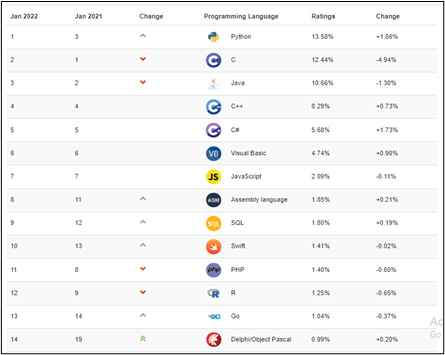
According to the TIOBE Index for GO, there has been a steady increase in the popularity of the Go language, it has gained one position more than the previous year. Securing its place at number 13.
1. Open Source: it is very important for a programming language to be open source to become better, cleaner, and more efficient. If a code has defects GoLang developers will detect and eliminate the problem.
By using open-source GoLang libraries, Dropbox has improved its caching, standard error interface, and connection management.
2. Learning curve isn’t steep: it’s easy to learn Go as it looks almost similar to other languages learned. The documentation is also easy.
3. Incredibly fast performance with heavy loads: Simple structure and syntax, devoid of class and inheritance, mainly works with functions so it’s simple and fast to learn. It is compiled so it provides faster feedback hence saving time and money.
GoLang is used by Daily Motion to automate API calls and end-to-end test cases. It is fast and powerful, so they choose GoLang for automating huge volumes of testing. Most backend projects are in GoLang because of its performance, static type checking, and simplicity.Even Twitch is using a combination of C++ and GoLang for delivering high-quality video streaming.
4. Ease of concurrency: with this open-source programming language concurrency is tractable and very easy. Requests are processed faster, freeing the resource for the network.
Uber which earlier used Node.js and Python has recently migrated to Go owing to its concurrency, and Go Memory model. They got high performance in throughput and latency. The response time was <5ms at the 95th percentile, and <50ms at the 99th percentile. They have written the Geobase program using GoLang.
5. Cross-platform: It can be compiled cross-platform to Windows, Android, Linux, and many more.
6. Easy Compilation: As Go has no virtual machine, it compiles directly to machine code.
7. Collecting Trash: The language makes it easier for the developers to perform activities like memory management by handling all runt work by itself.
8. The richness of the library: as it is adapted from C, C++, Java it has almost a collection of libraries similar to that of those.
9. Scalable: As it was designed by Google it was designed with scalability in mind and has many built-in functions to handle concurrency. An application can be scaled using Goroutines and Channels.
SendGrid’s earlier used python/Twisted has now switched to GoLang and they need to send over 500 million messages a day and they need a highly customizable, reliable, and scalable API. (Medium)
The fabric used GoLang for easy linear scaling and simplicity of code.
10. Cloud designing: Microservice and cloud computing are two great uses of Go. It is lightweight and cross-platform. Moreover, it compiles really quickly. So it is said to the language of the cloud.
Given its nature, Go is best suited to projects with growing user numbers and a large volume of requests.
Disadvantages of Golang:
- Metaprogramming: Developers need to code more to implement complex functionalities in Go.
- Non Reusable codes: It is harder to reuse code in Go than in other languages.
- It is new and still developing: being new language developers might find it difficult to make maximum use of the library. Lesser documented help is available.
- Lack of flexibility: this is a statically typed language that offers less flexibility of coding, as per those who prefer dynamically typed language.
- Too simple: in an effort to keep the programming language simple, several years of programming language progress are wasted.
- Poor runtime safety: the safety level is restricted mostly to compile-time to a certain extent to runtime. As it focuses on speed more
- GoLang doesn’t offer its own GUI Library.
What is Nodejs Vs GoLang Used for?
“Node JS is not a language but a runtime environment for Javascript,” which is useful for developing applications that require a persistent connection from the browser to the server and is often used for real-time applications like chat, news feeds, and web push notifications. It is intended to run on a dedicated HTTP server, the applications are event-based and run asynchronously.
GoLang is a procedural, multiparadigm, open-source, cross-platform, lightning-fast programming language created by Google developers in 2009 (dissatisfied with existing languages). Consequently, it combines the best functions of several programming languages, has similar performance and security characteristics to C, C++ with the speed of Python.
GoLang and Node.js Statistics and World Rankings
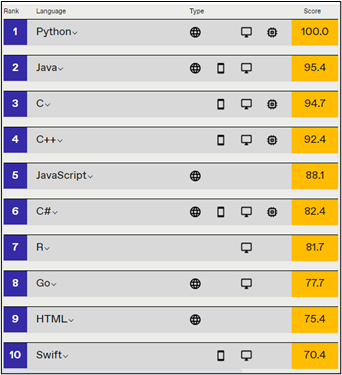
According to IEEE spectrum, the overall rating for Go is 8th where it is mostly famous for web as well as enterprise development needs, while that of JavaScript is 5th mostly for web application development.
According to TIOBE Index Go ranks 13th whereas Javascript ranks 7th for the year 2021
- To enhance the geofence lookup microservice, Uber even migrated from the Node.Js platform to GoLang in 2016.
- A Paypal released its report about the Java to Node.Js switching for their back-end operations for faster page serve and response time.
- Node.js is used by approximately 1.5% in the webserver of almost every well-known website. – Report by W3Techs
- Netflix observed a 70% reduction in startup time by adopting Node.Js – Report by Medium
- Golang has secured 5th rank as the most loved programming language – Survey and Report by Stack Overflow, 2020
Node.js vs GoLang – Big Names using them?
With the continuously changing requirements companies tend to switch to the latest or up-to-date tools and technologies in order to achieve the best performance. Below are some ‘BIG NAMES’ that adopted either node.js or GoLang depending upon their backend requirement. Some even migrated from node.js to go and vice versa.
| Companies using Node js | Companies using GoLang |
|---|---|
| Technology tools | Technology platform |
| Trello, Heroku, Coursera, Figma, Asana, Speed test | Dropbox, SendGrid |
| Websites | |
| NASA, Yandex, BBC, Washington Post, New York Times | |
| Online Booking | Online Booking |
| Uber | Uber, Delivery Hero, Trivago, Sixt |
| Ecommerce and retailers | Ecommerce |
| eBay, Walmart, Groupon | Alibaba, Allegro, Mercadolibre |
| Fintech and digital payment | Fintech |
| Citi Bank, Revolut | solarisBank, Monzo Bank, Capital One |
| Web browsing and hosting | Payment Processing |
| GoDaddy, Yahoo, Mozilla Firefox | American Express, PayPal, iZettle, Bolt |
| Streaming | Streaming |
| Netflix, Spotify | SoundCloud, Twitch, Movio, Dailymotion, youtube |
| Online blogging and networking platform | Chat Platform |
| Medium, LinkedIn, Twitter, UpWork | Stream, Clever, Slack |
| Data processing | Data processing |
| Samsara, TIBCO | Samsara, TIBCO |
| Real-time event Platform | Real-time event Platform |
| Riot Games, Nakama | Riot Games, Nakama, Farmville, Sarvest swap, Dawn of titans |
| Browsing and other | |
| Google, GOV.UK |
Node.js VS Golang – A complete Comparison guide.
Both Node.js and Go have distinctive advantages and disadvantages below. We have tried to highlight the differences depending on different parameters like architecture, speed, extendibility, error handling, syntax, universality, learning curve, and where to use.
| Node JS | GoLang |
|---|---|
| Architecture Refers to the structure of the software system. Explains how the software behaves. |
|
The architecture of Node JS helps in high speed and performance |
|
| Speed and performance Performance measures how quickly an application performs a task. The faster the code executes, the faster the response time. |
|
All the above points make Node JS perform with high speed and performance
So is slower than Compiled GoLang |
In terms of raw performance of memory-bound tasks, GoLang is a better option. |
|
Extendibility |
|
|
|
|
Error Handling |
|
| Node Js error handling mechanism is based on a throw and catches approach which is already quite popular among developers Though it sometimes displays some consistency issues at the end |
GoLang error handling demands explicit error checking to make it difficult to find the cause of the error Though the end result is consistent and flawless |
|
Syntax |
|
| Node JS syntax is quite similar to the browser’s JavaScript. Anyone familiar with Java can easily learn Node.js | GoLang syntax Is quite similar to that of C Language. |
|
Universality |
|
| Used for both backend and frontend development Used to develop web apps, desktop, and hybrid mobile apps, along with cloud IoT solutions Its cross-platform means a single desktop application that will work on Windows, Linux, and Mac. |
GoLang can be used mainly for back end development It’s cross-platform so the Go Program can run on Mac, Linux, and Windows Great for web and desktop development which need high security Weak for streaming |
|
Learning Curve |
|
| Node Js is one of the most widely used coding languages, easy to learn and switch. If the user is a little familiar with JavaScript he can easily use Node JS, so to learn node is easier | GoLang is a complete language. A web and Mobile App developer has to learn it from the start and be familiarized with its specific process, rules, interfaces, pointers, and other programming concepts |
| Where to use | |
| Real-time data streaming Low cost Less time Only one language |
High-performance Scalable apps Stringent security |
Node.JS Vs GoLang: Final Call
Although Node.js and GoLang are very different technologies, both are excellent choices for building robust and reliable backends. In development charts, Node.js often tops the list, but Go isn’t far behind. Both are renowned for their scalability, efficiency, and reliability. Node.js lacks concurrency and shows a decrease in performance where computing is required, Go seems less effective with real-time data streaming and intensive data processing.
Node.js is based on JavaScript and acts like a complete package (frontend as well as backend) while the use of Go is restricted to backend development only (one needs to hire an additional developer for the frontend). So before choosing any of this language we should strongly take into consideration the pros and cons of GoLang and Node.js
References and terms
- Open source is source code that is made freely available for possible modification and redistribution.
- Threaded: In computer science, a thread of execution is the smallest sequence of programmed instructions that can be managed independently by a scheduler, which is typically a part of the operating system.
- Cross-platform: software that is designed to work in several computing platforms.
- Full-stack: A full-stack web developer can be defined as a developer or engineer who works with both the front and back ends of a website or application
- MEAN tech Stack: MEAN(MongoDB, js, AngularJS (or Angular), and Node. js)[1] is a free and open-source JavaScript software stack for building dynamic websites and web applications.[2]
- API: An application programming interface(API) is a connection between computers or between computer programs
- Multiparadigm: Using or conforming to more than one paradigm. The multiparadigm programming language supports both object-oriented and aspect-oriented programming.
- Metaprogramming: Metaprogramming is a programming technique in which computer programs have the ability to treat other programs as their data. It means that a program can be designed to read, generate, analyze or transform other programs, and even modify itself while running.
Read More:
Node.js vs PHP: Which is better for backend development?
NodeJS vs AngularJS: Which is The Best For Your Project?
Flutter vs. React Native – What to Consider for your app in 2022?
Want to build apps as quickly as possible? And not sure whether to consider Flutter or React Native development services? Read on as here is a complete guide for app and business owners to determine which framework Flutter vs React Native is an ideal fit for your cross-platform app development. Get the brief history of Flutter/React-Native along with the top apps developed by Flutter vs React Native.
In this blog post, you will get Flutter and React Native with the best Flutter and React Native app examples. So, let’s dive into this.
Flutter vs. React Native: A brief comparison:
| Comparison | Flutter | React Native |
| Release date | May 2017 | March 2015 |
| Type | Software development kit | Software framework |
| Who created this? | ||
| Programming language | Dart | Javascript |
| What popular apps are made with this? | Google ads app, Hamilton, Xianyu, Philips Hue, Reflectly, My BMW, etc. | LinkedIn, Instagram, Facebook, Facebook Ads, Skype, Tesla, etc. |
| Popularity | On Github, 120,000 stars (May 2021) |
On Github, 95,300 stars (May 2021) |
| Time to market | Much faster than native development typically | With Flutter, as fast as development possibly |
| Testing | Rich set of testing features to allow developers to perform integration, unit, and widget testing. | For testing the app, React native framework using the third-party tools. |
| Native performance | Fast and great native performance | Slow and less effective performance |
| Architecture | Uses business logic components (BLoC) | Uses Redux and Flux (created by Facebook) |
| Target audience coverage | Low | High |
| Community support | Less community support than React native | More community support than Flutter and solve questions & issues |
| Deployment cost on multiple platforms | Quite expensive because the Native code need to write from scratch for each platform | It saves a lot of money and time because of the cross-platform compilation on all target platforms |
| User Interface (UI) | Create app UI using custom widgets | Create app UI using native UI controllers |
| Challenges | Target platform restricts the app design and functionality, Easily implement the platform-inherent features | The target platform doesn’t provide some important features and it needs to implement manually |
| Documentation | More informative, good, and organize documentation | User-friendly but disorganized documentation |
| Latest version | Flutter-v1.12.13 | React Native-v0.61.0 |
Flutter vs React Native Introduction & Overview:
Let’s first cover the fundamental details about these two cross-platform app development technologies.
What is Flutter?
Flutter is a portable UI toolkit. To put it in simple words, it’s a comprehensive app Software Development Kit or SDK, complete with tools and widgets. Flutter allows cross-platform app development. It gives app developers an easy means for building and deploying visually appealing, natively-compiled apps for mobile, web, and desktop – all utilizing a single codebase.
A team at Google created Flutter. However, as an open-source project, Google, as well as the Flutter community, contributes to its further development.
Below is the list of famous apps made using Flutter:
- Xianyu by Alibaba – one of the biggest eCommerce firms in the world.
- Hamilton – official application for the Broadway Musical
- Google Ads app
- Reflectly
- Topline by Abbey Road Studios
Features of Flutter:
Flutter gives you easy and simple ways to create beautiful mobile and desktop apps with an extremely extensive selection of material design and widgets. The most significant features of Flutter include:
- It’s free as well as open-source
- It’s based on Dart – a quick, object-oriented programming language. Google launched Dart 2.3 with support for UI-as-code features. Dart is currently in its 2.6 version. It is relatively new and very easy to learn, particularly for experienced developers who are more familiar with C# and Java.
- The architecture is based on the very famous reactive programming – it pursues the same style as React.
- It offers its widgets – these are attractive, fast, and customizable.
- Because of the Widget experience, Flutter apps entail an amazing look and feel.
What is React Native?
It is an open-source mobile app framework that utilizes JavaScript. React Native is a potent framework for the following:
- Cross-platform development
- Developing mobile applications utilizing JavaScript language
- Building apps for both iOS and Android utilizing a single codebase.
- Utilizing the same design as React.
Keep in mind that applications developed utilizing React Native aren’t mobile web applications. React Native utilizes the same basic UI building blocks as standard Android and iOS apps. This implies that rather than developing in Swift, Java, or Kotlin, you’re placing the same building blocks together, utilizing React and JavaScript. And React Native utilizes components analogous to Flutter’s widgets.
Facebook is the one that created React Native.
Below is the list of popular apps developed using React Native:
- Skype
- Tesla
- Wix.com
- FB Ads Manager
Features of React Native
- React Native provides many advantages in the creation of mobile-based apps. A few of the most important functions available in React Native are given below:
- React Native is open source and free Source. This means that anyone can use it easily.
- It gives users the capability to “Write once and use it across all platforms” It lets you develop applications that can run on Android, iOS, and Windows platforms.
- React Native is focused primarily upon UI. It creates an interface that is extremely fluid.
- React is a powerful and efficient technology. React Native is built in the native language. This allows it to run on any operating system to provide more functional and native-looking features across every platform.
- Hot Reloading involves making small changes to your application’s code which will be visible immediately during the development process. If the logic of business is changed the reflection of that logic is live loaded and displayed on the screen.
- React Native is compatible with many third-party libraries to create an application that can be interactive.
- Developing faster Rapider Development Native lets you reuse the code you’ve previously created. This feature lets developers develop apps faster. It uses an open language to build applications that work across Android, iOS, and Windows platforms.
Flutter vs React Native Statistics:
The growth of mobile apps has significantly affected the development field. With an estimated 3.6 million mobile users across the globe, the development of mobile applications demands innovative solutions that are more efficient and less time-consuming. In 2021, two major hybrid frameworks that used to create apps: Flutter vs React Native. Both are well-known and their usage of them is increasing.
42% of programmers choose React Native for building apps and Flutter is preferred by 39% of programmers by the year 2020. Flutter framework has been used by more than 2 million developers and more than 500,000 people utilize it each month. These numbers are astounding but they are largely dependent on the performance of mobile apps and their customers.
92% of mobile users spend their time with apps as well as social networks, but only 8% use websites. For entrepreneurs making their website accessible on every platform is vital and they want to engage customers through various methods.
Pros and Cons of Flutter and React Native:
When we search for the benefits of Flutter vs React Native then both have several features that they have in common. It is the fact that they are not native, which could create some problems with the process of development. With a good library and assistance, there are no advantages. We suggest taking a look at the pros and cons associated with Flutter and React Native to identify the factors that are crucial to you.
The key pros and cons of Flutter or React Native for app owners depend on their requirements. When you’re having a hard time deciding whether to go with React Native or Flutter development services, the best thing to do is to check out the Flutter vs React Native cross-platform app development technologies with pros and cons.
Advantages of Flutter:
There are so many advantages and disadvantages of using the Flutter as like any other framework. We can develop web, desktop, and mobile apps with Flutter and get the best Flutter’s desktop and web support.
Choosing the best frameworks for cross-platform application development is an important task by comparing the performance of both the frameworks and also it is up to the developer. Below is the list of Flutter pros:
Below is the list of Flutter pros:
- Hot Reload = Fast Coding
Flutter provides a more dynamic and quicker app development. It is one of the amazing things that Flutter entails and is loved by every top mobile application development firm. Developers can do modifications to the codebase on the fly and witness them right away reflected in the app. It is the so-called Hot reload feature and it usually takes milliseconds for modifications to show. The feature assists teams introduce features, resolving bugs, and experimenting using new ideas.
- One Codebase, Two Mobile Platforms, and More
Using Flutter, app developers can write one codebase for two apps – covering both Android and iOS platforms. This cross-platform development technology is platform-agnostic as it entails its own widgets as well as designs, implying you can have the exact same application on two platforms.
- Ideal for MVPs
If you have to develop an MVP for your application, Flutter is the ideal choice, particularly if you’re short on time.
Disadvantages of Flutter:
While Flutter’s list of benefits is impressive, there are a few cons that are still to be assessed. In some cases, the benefits and cons of Flutter can be an important consideration when choosing the right framework to develop with that’s cross-platform.
Below is the list of Flutter cons:
- Support and Libraries – Impressive but Yet Not as Rich as Native App Development
For Flutter, Google’s support is impressive. However, it is yet quite new. It implies that you can’t always have the functionality you desire in existing libraries; thus, your developers may have to develop custom functionality on their own and it takes time,
- Platform Risk
Though Flutter is open-source, if Google concluded to pull support for the project, it would lead to disaster. That said because the Google team launched the Flutter beta version and it has just ramped up its efforts, as demonstrated by Flutter’s prominent role during Google IO ’19, along with the latest Flutter Live event.
Advantages of React Native:
Both the Flutter vs React Native frameworks have some peculiarities that attract the developers more or less. If you are still confused about whether React Native is worth it or not, the pros and cons below will help you make your mind.
Below is the list of React Native pros:
- Fast Refresh = Fast Coding
In essence, the same features are just like Flutter. Hot Reload tends to speed up the app development procedure by enabling an app developer for injecting new code directly into a running application. Thus, a developer can witness changes right away, without redeveloping the app. To enhance the developer experience through hot reloading, the React Native team incorporates in the 0.61 version a new feature known as fast refresh unifying live and hot reloading.
- One Codebase, Two Mobile Platforms, and More
Like Flutter, you can write a single codebase in order to run two applications and cover both Android as well as iOS platforms. Better yet, JavaScript offers you a leg up while writing cross-platform apps by sharing code with web apps. It is achieved by formulating abstraction parts you can compile for targeting platforms.
- Freedom of Choice
React Native allows developers to develop cross-platform applications – no more and no less. It enables developers to conclude precisely what solutions they like to use – in accordance with the project’s requirements and the developer’s preferences.
For instance, if a developer wants to conclude how to tackle the global state, select a router library, or select between TypeScript or JavaScript.
Disadvantages of React Native:
React Native limitations or cons evident that no tool or framework is perfect when we talk about any of the cross-platform development.
Below is the list of React Native cons:
- It Isn’t Actually Native
Like any cross-platform technology, neither the performance nor the UI experience will be the same as in native applications – merely close.
However, yet, it is easier to accomplish a “native feeling” through React Native than Flutter.
- Fragile UI
React Native utilizes native parts under the good should offer you confidence that, after each OS UI update, your application components will be right away upgraded. That said, this could break the application’s UI but it occurs very rarely. On the other hand, with Flutter, the application UI is quite more stable.
9 Top Differences between Flutter and React Native:
In this software development, both these Flutter vs React Native share the same core features and occupy the same niche. In the Flutter vs React Native differences, we can compare their platform support, performance, project size, etc. but both are good at building mobile cross-platform MVP by re-using the code later.
Now, the question is – How are they different? What is the main benefit of Flutter over React Native? and vice-versa. So, let’s start the Flutter vs. React Native comparison and dive deep into this.
1. Flutter vs React Native platform support
Flutter’s tools aren’t exclusively for mobile or the internet, but embedded devices and desktops too. It’s helpful for applications that are designed to work on any device, including smartphones, tablets, laptops, or even an information system for the automobile display.
2. Flutter vs React Native Performance
Flutter projects follow native code, leading to overall better performance, and here’s a case study to illustrate this. However, it has performance issues when the graphic routine it’s using isn’t regularly optimized.
3. Flutter vs React Native – Installation
Installation is an essential element when considering the two different platforms. Installation should be simple and free of complex installation procedures. In addition, the entire process of installation must be described in the official documentation for use.
You can install Flutter by downloading the binaries of the platform on their official site and then setting some path variables. In addition, React Native can be quickly downloaded using the NPM. Developers who have a background in JavaScript are in a position to get React Native up and running.
4. React Native vs Flutter Apps Graphics and Design Capabilities
All of React Native, as well as Flutter, are incredibly attractive, However, they employ completely different techniques to create User Interfaces. High-quality graphics with perfect pixels and flawless animations are possible making use of each technique.
React Native is a native app that inherits its native style and functions such as buttons and navigation menus buttons, and more. These elements appear natural to the user and provide a seamless user experience. When updates to the operating system components are made, they will be updated and maintain the feel of being native and resembling native applications.
With Flutter, the app will appear identical, regardless of the model or version of OS. The navigation and the other features won’t change unless modified by the program’s development team. If your app was created in a hurry or is not properly designed, Android users could catch bizarre menus that look similar to iOS as well.
5. Flutter vs React Native project size
React Native projects tend to be lighter. This might not seem an advantage at the moment but consider small wearable devices. You must be aware of the free space used.
6. Flutter vs React Native Architecture Support:
It is important to note that the Flutter structure is multilayered. The structure of an application developed using this framework starts with the most basic root functions, specifically designed for specific platforms.
There are the widgets that function with the platform and the render layer. In the rendering layer, there are animation gestures that send API calls to the core part of the application. Also called Scaffold, it operates with an engine in C/C++, and is more specifically embedded for this platform.
Under the hood, React Native possesses a bridge that connects the Native thread to its JavaScript thread. In this way, the JavaScript code can interact with the device, as well as can communicate with the Native API. For iOS, React Native uses JavaScriptCore independent of the JavaScript code, while it integrates JavaScriptCore within React Native for Android.
7. React Native vs Flutter Compatibility, App Features, and CI/CD
Flutter is compatible in various resolutions on devices that run Android 4.1+ OR iOS 8+. React Native supports Android 4.1+ and iOS 10+. In some cases, there is the possibility to add Native development for each of Flutter and React Native for more advanced features. Writing native components could help with some issues, but they will reduce the benefits of keeping the cross-platform solution since it requires a variety of tools to make minor modifications to.
Furthermore, it takes longer and takes more effort than conventional Android and iOS creation. Widgets created in Flutter or already built libraries in React Native typically contain native code injections as well. This allows for near-native performance, integrating complex features, as well as communicating with the hardware of devices.
8. Flutter vs React Native Popularity, Market Shares, and App Examples
Based on Stackoverflow’s research React Native is in 6th place and has 11.50% of votes of the most used non-web frameworks, libraries, and software. Flutter with 7.20 percent votes and sits 9th. Together, they make up the two most popular cross-platform software.
According to the TIOBE index, JavaScript (React Native) was ranked 7th in the top software languages in the world. This isn’t any surprise considering the wide range of frameworks and solutions for that it’s utilized. Dart’s popularity decreased from 24th to 30th last time. The height of its popularity is the date of its first release.
From an adopter’s point of view, React Native currently is the most popular application when it comes to acceptance. Flutter has witnessed a significant growth in the time that it has been in the market however, despite expanding its reach it’s fighting hard to keep up with React Native.
9. Flutter vs React Native Ease of Testing
The effortless execution of code that takes the most work and energy is one of the primary goals of creating. In this section, we’ll have a look at how simple to make testing using Flutter and React Native applications.
How easier is it to test a Flutter VS React Native app?
Flutter nevertheless offers many options to automate testing because it is a built-in dart. It does not just offer a range of tests for testing applications at the widget, unit, and integration levels, but also in addition to complete documentation of the application.
Furthermore, Flutter has comprehensive documentation for users to build and publish Android or iOS applications to as well App Store and the Play Store and App Store and App Store and App Store, respectively. Additionally, Flutter has its deployment process also documented.
React Native is proud of the absence of officially recognized support of UI level testing or Integration testing. In addition, it’s only certain unit-level testing frameworks that could be utilized for testing RN software. Without official support, developers have to depend on third-party software like Appium or Detox to identify bugs with the tools.
When Choose Flutter, if:
- Your concept doesn’t need an entire native function.
- You have the constraints of your budget and timeframe to complete.
- You’d like to write faster codes and then release them to the market quicker.
- It’s your goal to reduce development costs by creating a single codebase that supports different platforms.
- You’d like to build applications that run at a speed of between 60 and 120 FPS.
- The aim is to customize the UI through widgets and also to reduce testing.
When Choose React Native, if:
- You’re planning to extend your current applications with cross-platform apps.
- The objective is to develop light Native applications which are lightweight as well as portable.
- You’re looking for ways to build shared APIs out of the box.
- The aim is to develop an app that’s synchronized in its development and has highly flexible in its user’s interface.
- You’ve got enough time and money to put into the business.
Future of Flutter & React Native – Which one to Choose in 2022
- A rising number of businesses are attracted to Flutter. At the end of the day each month, we’re seeing enhancements in Flutter’s Flutter SDK since Google is constantly improving its Flutter tool. Furthermore, the Flutter framework for web or desktop users is always helpful and encouraging.
- Furthermore, Flutter lets us create not only mobile apps as well as apps for desktops as well as webs. (Flutter’s desktop-specific support is now available in a beta release on stable channels. ).
- Overall, when you consider that some of the biggest companies such as Alibaba have already implemented Flutter The future is bright for the Flutter toolkit as a toolkit.
- In the context of React Native Well, Facebook is currently working on a major overhaul of React Native.
- Its team is doing to improve support for React Native users and the wider crowd. In addition, it’s now possible for users to propose improvements to the core features of the framework using an RFC process that is based upon the exclusive GitHub repository.
The actual results of these enhancements in architecture include:
Hermes is an open-source JavaScript engine that has been optimized for mobile applications that improve the speed of interaction, as well as reduce the size of the application and the amount of memory used.
Significant changes introduced with the 0.60 Version (find the full summary on this page):
- It’s much simpler to manage iOS dependency using the most well-known tool for managing dependency CocoaPods by default.
- You can also move React Native onto AndroidX,
- You can avail of features available as an integral part of the core’s lean process.
Establishing an open discussion space regarding React Native is a significant step. It’s an indication of the technology’s continuous advancement and also a signpost for the future of the technology.
Based on React Native is in being able to maintain its market position and is on the path of continuous development and growth, it’s not likely that we’ll disappear soon.
Yet, Flutter is an imposing rival to React Native.
Flutter vs React Native – Who is the Winner?
React Native and Flutter both the framework have some pros and cons but Flutter does a great job of creating MVP apps and came out as the winner in this software application match. While React Native is good at building simple cross-platform and native apps. Some predictions by industry experts say that Flutter is the future of mobile app development but don’t blindly trust these predictions and compare both the frameworks on your own.
So, which one to consider whether to go with Flutter development services or React Native? It entirely depends on your project’s requirements and the balance of your app developer team’s skills. For instance, if your developers are aware of Dart, then Flutter is the right option. If your developers are good at JavaScript, then go with React Native.
You can get in touch with expert developers at Hire Indian Programmers and seek guidance on the type of development services that will best fit you. You can hire Node.Js developers, Android developers, iOS developers and Angular developers from us.
Read more of our in-depth blogs:
How much does it cost to hire a programmer?
How to hire a programmer for a startup?
The Advantages of Node.js – A Complete Guide
Node.js vs PHP: Which is better for backend development?
8 Key Reasons to Hire Dedicated PHP Developers
Is your business looking to build a PHP-based robust website or application? But it’s easier said than done because it takes expertise and knowledge to develop a perfect website or web application.
PHP’s latest version has proven to be one of the most robust techniques globally to create top-notch websites and web applications, thus making PHP version 7 one of the most popular hosting platforms. In addition, PHP’s advanced versions have several key advantages that are worth considering when developing web applications.
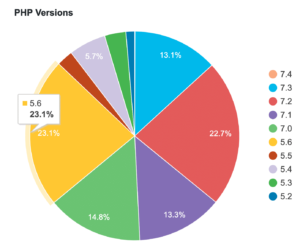
The importance of PHP makes it no surprise why hire dedicated PHP developers. It is because they are always in demand.
As a result, to create a robust website or application for your business, you will have to hire PHP developers, and the right team of experts will help you create a robust website or application that meets your requirements. Thus, getting the right PHP developer is very crucial to a successful business.
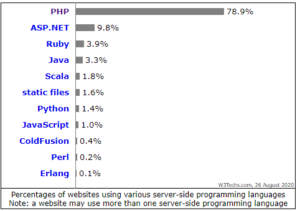
But before we move on to the hiring process, let us understand who a PHP developer is? What are their roles and responsibilities? What skill-sets are required from them? Finally, and most importantly, what are the reasons to hire dedicated PHP developers?
Who Is A PHP Developer?
Those who develop programs, applications, and websites using PHP are known as PHP Developers. Software Developers and Web Developers may also be more generally referred to as PHP Developers, though they are a team of developers in their genuine sense.
A PHP developer should build a wide variety of projects beyond the simple creation of code for web pages. Solving problems analytically and logically is required to achieve this. Moreover, good PHP developers should collaborate with other developers to create applications and troubleshoot issues as needed.
Now that you know who a PHP developer is, let’s discuss their roles and responsibility:
Roles And Responsibilities of PHP Developers
There are uncountable responsibilities of a PHP developer for building powerful web applications. They always try to deliver such a website that meets clients’ requirements. The below points give a clear idea about the roles of PHP developers in-depth.
- Work with other developers to meet the specific requirements for each project while simultaneously creating, testing, and deploying innovative web applications.
- Addressing the issues found in websites or applications based on tests performed across several different devices and browsers.
- Study various updating considerations related to designing a system, including web user experience and site performance.
- Evaluate and experiment with different options to include in new applications.
- Establish a plan for keeping the website updated at all times and propose changes that will positively impact its performance.
- Choosing the most appropriate design tools and other programming languages for applications.
- Attending training sessions, workshops, and conferences keeps you up to date on the newest programming practices.
Skill Set Required from PHP Developers
- Expertise in multiple programming languages
- Problem-solving
- Adaptability
- Good communication.
- Knowledge of best practices in PHP
Why You Should Hire A PHP Developer?
In an era of technological advancements, it has become vital to create reliable and cost-effective applications. As a result, a large number of businesses rely on PHP websites to build advanced applications. These businesses choose PHP because of its many benefits.
In addition to the fact that PHP can accomplish almost anything, different PHP frameworks available and widely used in education are three main reasons PHP is so popular. This strongly explains why there is high demand and why hire dedicated PHP developers.
It is essential to hire experienced PHP developers for your business to get the best results out of it. In addition, only a professional PHP developer will understand how to customize your website and the application tailored to your business needs.
In an attempt to give you some insight into why you should hire a PHP developer, here are several reasons:
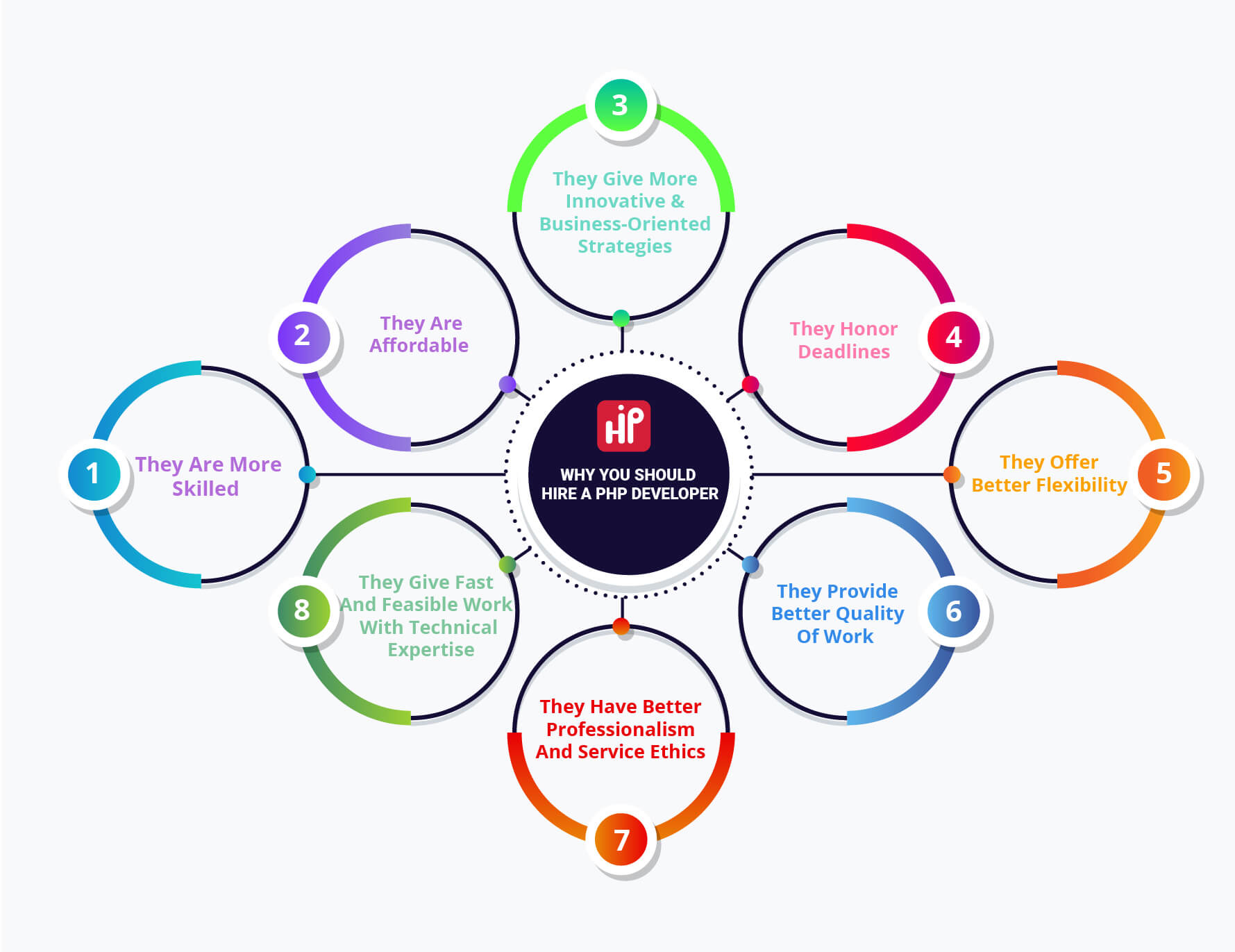
1. They Are More Skilled
The PHP developer’s expertise in the technology for launching your business conquers just as strong as your knowledge of your business.
Their technical expertise helps them to make dynamic and smooth applications that perfectly fit your business needs. Companies hiring coders and developers typically follow their recruitment procedures.
Therefore, your projects would be handled by highly qualified and experienced programmers. By infusing your work with innovative ideas and new perspectives, your quality of work will significantly improve.
2. They Are Affordable
Perhaps you think that the cost of hiring a PHP developer will be a strain on your budget. That’s not the case. They’re pretty reasonably priced. Considering the developed web apps, these developers reduce their development costs, making it more affordable for your business.
This adds more credibility to the service they deliver and is one of the main reasons you should hire them.
That is why hiring PHP developers is beneficial for new companies that operate on a strict budget.
3. They Give More Innovative & Business-Oriented Strategies
PHP developers offer a level of innovation that no one else can. They will apply an innovative, creative, and passionate approach to creating the project by incorporating absolute best practices.
Also, you must make sure that they can provide unique solutions for PHP development following your requirements. Finally, to appeal to more customers, you can use the developers at your disposal to provide a better web solution different from the norm, allowing you to capture more business.
4. They Honor Deadlines
You might experience delays in several aspects of your business if your website is not ready when you need it. That is why you need to work with a PHP developer that specializes in working with companies.
Whenever you hire a PHP developer, you can ensure that your project is handled by a whole team of designers and developers. They adhere to deadlines when they are working on projects for you. As a result, your task is delivered in a timely fashion.
In case one developer isn’t available, there is always an entire team to support them.
5. They Offer Better Flexibility
No matter where they are located, PHP developers can work for you from anywhere without necessarily coming into the office. Despite this, these developers are extraordinarily competent, and they can complete any project with tremendous speed and agility.
Also, you can even access the project from remote locations at both ends. Thus, you will be able to monitor progress, analyze their ideas, and discuss your plans, ultimately ensuring the successful completion of the project.
6. They Provide Better Quality Of Work
Due to technological advancement, there is always high competition in every business regardless of the domain. This has led many business owners to invest wisely in the technology industry. Because at the end all business owners want their business to perform well and have good profits.
PHP developers have the capability of creating the best quality dynamic websites without incurring too much expense. They also provide visitors with better information and more relevant results. Which in turn helps businesses generate greater returns on investment.
7. They Have Better Professionalism And Service Ethics
A PHP developer adheres strictly to the timeline during the execution of the project, and the developer works diligently to ensure timely submission. By overcoming all those challenges, they come out even more robust and offer even greater technical assistance. The results came out stronger than expected.
And, once a website or application is created, the programmer’s work is not over. Testing and implementation are among the crucial tasks remaining. Even a single error can crash the PHP framework, so the testing process is vital in the development process. Here, you can trust the expertise and experience of these developers.
8. They Give Fast And Feasible Work With Technical Expertise
Having profound technical expertise is crucial to the success of a PHP web development project. Therefore, professional PHP web developers can provide the best results due to their deep technical expertise and knowledge.
You will be able to take advantage of the technology brought to you by PHP developers. They will devise a customized method to handle your project’s development most creatively and passionately. Furthermore, these developers use the most recent tools and technologies to deliver the best result for your business.
Common Services Offered By Dedicated PHP Developers
PHP developers offer unparalleled capabilities for developing robust digital experiences that strengthen customer-brand relationships and sharpen your competitive edge.
Some of the services offered by a PHP developer include:
- Web application development
- Web portal development
- CMS portal development
- eCommerce development
- Upgrade existing PHP applications
- API development
7 Things To Know Before Hiring A PHP Developer
PHP has been proving to be a robust and reliable technology in creating top-notch websites and web apps in the online world. However, if you plan to run a profitable business, you must hire a PHP developer. You can create a unique web solution for your business if you choose the right PHP developer.
So let us discuss the things that you should look out for when hiring a PHP developer:
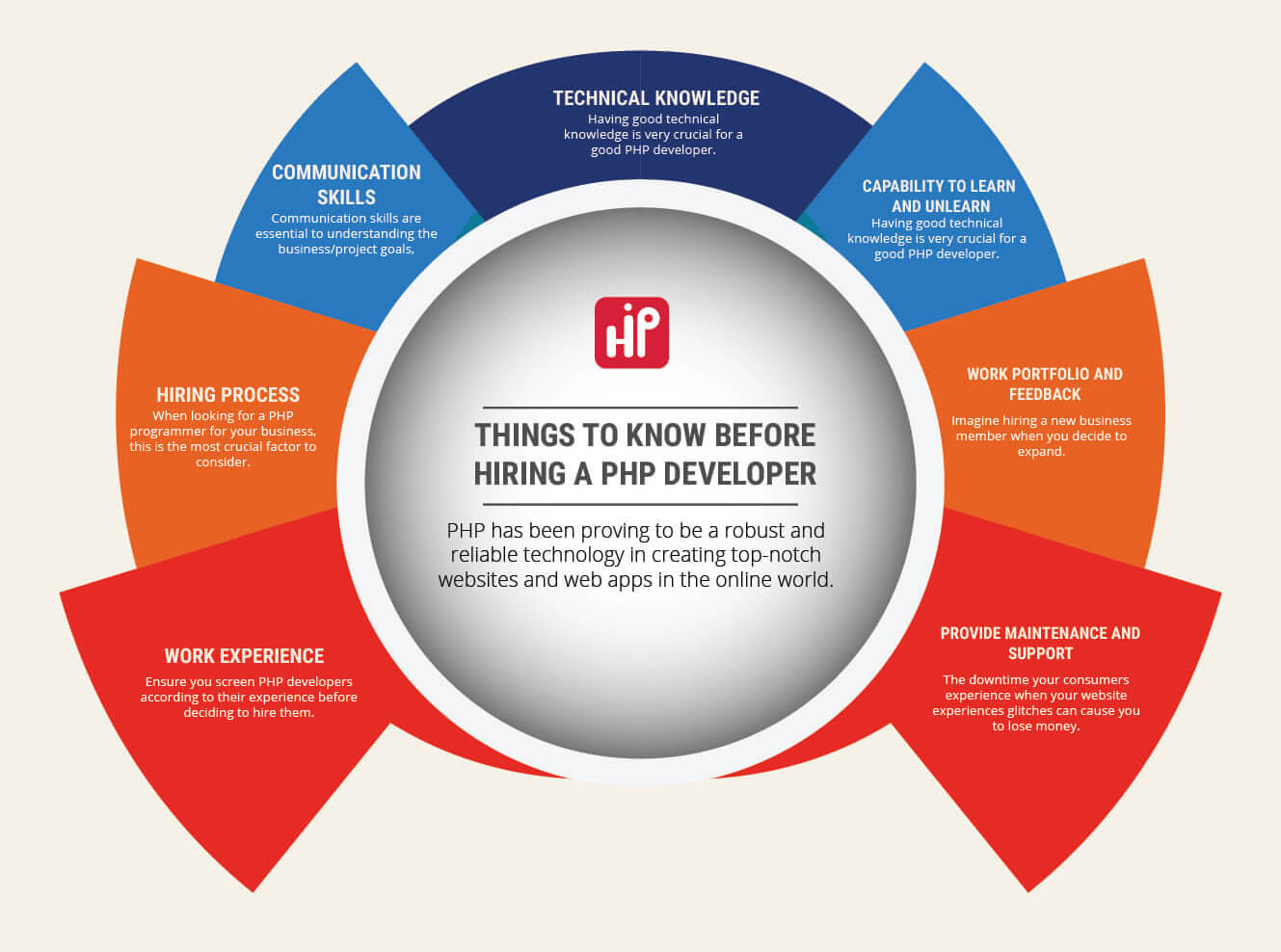
1. Work Experience
Ensure you screen PHP developers according to their experience before deciding to hire them. You might have to put a lot of time and effort into filtering out those not experienced in designing and developing websites.
Also, before you finalize your option, make sure to check the technical knowledge of the PHP developers. Further, check that they are updated on the latest tools and information necessary to achieve success.
2. Hiring Process
When looking for a PHP programmer for your business, this is the most crucial factor to consider. The hiring and engagement models influence the overall design of a website.
You can also choose to hire a freelancer, whose services will undoubtedly be less expensive than hiring a PHP developer from a proficient company. Still, you may not be able to appreciate the kind of services they offer.
You should hire developers from a reputable PHP web development company whenever possible since you can pick the type of developer you want to work with. Also, you will be provided with a full-time team that will work on your project, making the outcomes in general much more secure and reliable.
3. Communication Skills
Communication skills are essential to understanding the business/project goals, resolving problems, and explaining how your contribution is connected to the project.
PHP code wizards may be great at writing code, but if they have difficulty communicating with anyone else, they will struggle to work on a team project effectively. You should keep this in mind even when you are at your most comfortable when messaging, e-mail, and video conferencing.
4. Technical Knowledge
Having good technical knowledge is very crucial for a good PHP developer. In addition, there are multiple languages in which they have to be proficient and keep honing their developing skills. Knowledge of Ajax, MYSQL, CSS, jQuery, JavaScript, etc., can make a huge plus point when you’re looking for a full-stack PHP developer.
Also, a good PHP developer knows the technical aspect of business, making it easier for them to build a robust and smooth functioning application that suits your business needs.
5. Capability To Learn And Unlearn
The two most important things to learn and unlearn new concepts are adaptability and willingness. The development of PHP, like any other programming language, evolves constantly, and organizations are most likely to hire developers who stay current with translations, application updates, and platform improvements.
As a developer, they should be willing to unlearn as well as it is never too late to learn things from others, regardless of how confident you feel about your PHP abilities.
6. Work Portfolio And Feedback
Imagine hiring a new business member when you decide to expand. But Is it necessary to hire him right away? Not necessarily! It’s a good idea to have a thorough background check, right? Because you can predict the candidate’s future performance by knowing their past and current works.
Whenever you interview a PHP developer, verify the portfolio and previous experiences and make sure the PHP developer you are likely to hire has a good portfolio and a good client base before you hire them.
Additionally, you can check out their reputation online to guarantee you get the right team.
7. Provide Maintenance And Support
The downtime your consumers experience when your website experiences glitches can cause you to lose money. The right PPH technology partner will play an essential role in your website’s success because they can and will assist you with timely support to resolve any issues and ensure 100 percent availability.
By improving your website’s performance, they help you avoid technical problems. In addition, PHP developers have good testing skills and the ability to find and fix errors which helps your business.
So, you must make sure that reputable and reliable developers handle your website maintenance.
4 Steps To Successfully Hire PHP Developers
Now that you know who PHP developers are and their duties and things to look out for when hiring one. But to hire a good PHP developer, it is essential to fully understand your requirements and follow a hiring pattern. Here we have crafted a hiring pattern that makes it easy for you to hire PHP developers successfully:
1. Categorize
It is crucial to categorize your requirements before hiring PHP developers. PHP developers can be divided into three categories based on the skills needed for a PHP project:
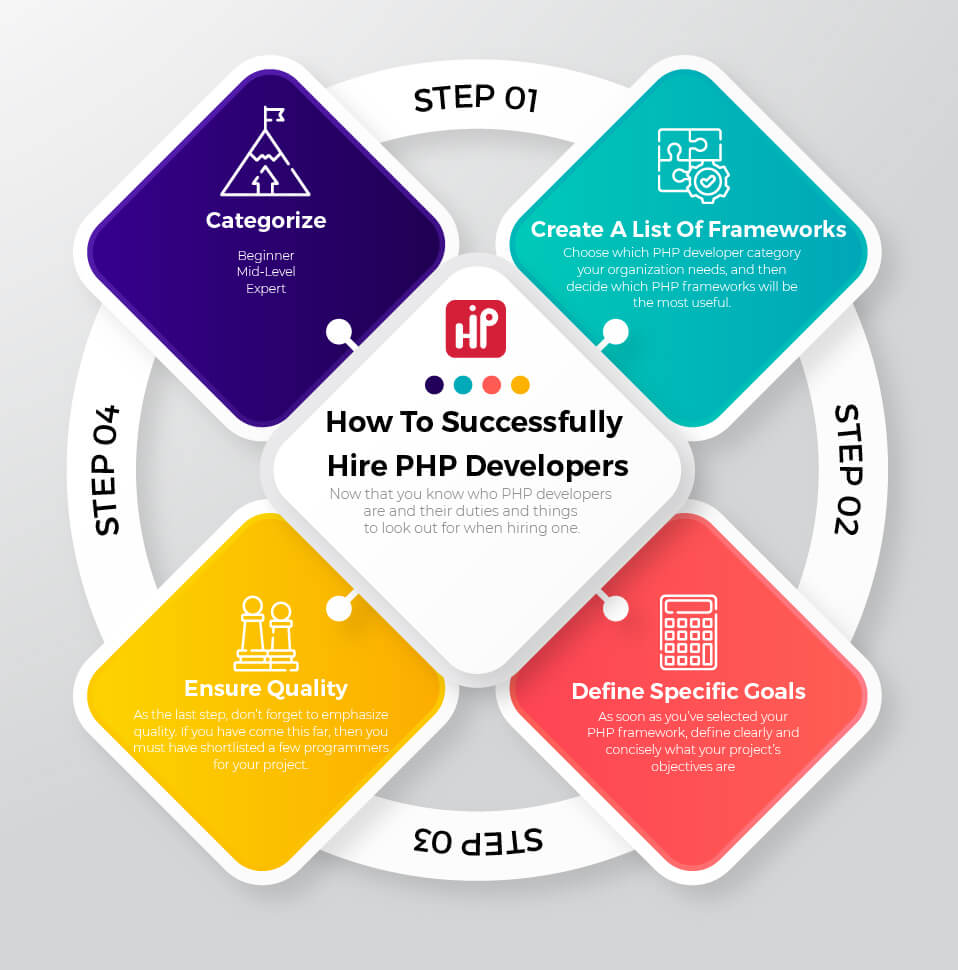
- Beginner
The beginning developer is just learning the fundamentals of PHP development. Although they fully understand the underlying concept used in the programming language. Medium-sized and straightforward projects are best suited for beginner PHP developers.
- Mid-Level
These individuals have already built some web applications and have some project development experience in their portfolios. The developers are quite experienced and are capable of working independently without having to be closely monitored.
- Expert
PHP experts use the latest technologies and practices in web development and are specialized in specific areas. They are adept at analyzing requirements and suggesting how to make the product more secure and efficient, improve your software’s source code and point features.
2. Create A List Of Frameworks
Choose which PHP developer category your organization needs, and then decide which PHP frameworks will be the most useful.
Each PHP framework provides different types of functionality and development scenarios. Also, some developers prefer to work on a specific fixed framework. That is why it is very crucial to opt for the proper framework.
As per research by JetBrains:
- 67% of people use Laravel daily
- 24% of people use Symfony daily
- 9% of people use Codelgniter daily
- 4% of people use CakePHP daily
3. Define Specific Goals
As soon as you’ve selected your PHP framework, define clearly and concisely what your project’s objectives are. If you narrow down the functionalities you’ll need for your project, you will simplify the hiring process.
The developers should understand all the project information and requirements at the beginning. If you have focused on your development goals, the development team will know the project scope and budget while attracting the best developers.
4. Ensure Quality
As the last step, don’t forget to emphasize quality. If you have come this far, then you must have shortlisted a few programmers for your project.
There are many cross-functional disciplines involved in developing software. IF the PHP development is based on faulty code, then the whole cross-functional execution will be flawed. That is why you should ensure the final stretch must be based on high-quality development and delivery.
Best Option To Hire PHP Developers Online – A PHP Development Company Or Freelancers?
Hiring a good PHP developer to scale your business is very important. But there is a lot of confusion about hiring a freelance PHP developer or a PHP development company. To save you from chaos, we have curated a list of both advantages and disadvantages. First, you should go through these pointers and finalize who you want to hire:
1. PHP Development Company
Many companies offer good-quality PHP development work. Therefore, it is essential to understand the disadvantages and advantages of a PHP development company if you plan to hire them.
6 Advantages of hiring a PHP Development Company:
1. Experience
PHP programmers with years of experience in this area are provided by companies that specialize in PHP development.
2. Expertise
PHP developers who work for web development companies are highly experienced in many different fields of web development.
3. Timely delivery
To ensure timely delivery of the product, PHP companies follow a well-established workflow.
4. Best Development Practices
They always follow the best and latest development practices to deliver a good quality product.
5. Certified PHP Developers
Getting access to certified PHP programmers is one of the benefits of hiring a PHP development company. Interviews and tests will be conducted before the PHP development company employs PHP developers.
6. No Supervision Required
Using a freelance PHP developer means that they don’t have to be supervised. However, freelancers must update their knowledge of the latest technologies and practices to be the best in their field.
3 Disadvantages Of Hiring A Php Development Company:
1. Extra Charges
You might incur extra costs if you did not adequately choose the right PHP development company.
2. Number Of Revisions
In some cases, PHP development companies and clients may agree on the number of revisions before starting a project. The client is bound by the contract only to accept so many modifications. If more is needed later, it will be outlined in the agreement.
3. Higher Cost
PHP development companies charge a higher fee because they provide instant replacements if you don’t like the developer or leave the project for some reason. When hiring a company to handle PHP development, the client is supposed to cover all expenses.
2. Freelance PHP Developer
In the case of budget constraints, it is best to hire freelance PHP developers. However, before you hire a freelance developer, you should know what the downsides and advantages are:
3 Advantages Of Hiring A Freelance PHP Developer:
1. Cost-Effective
Getting a freelance PHP developer is a good option for startups because they are generally cheaper than other options.
2. Global Exposure
It is widespread for a freelance PHP developer to work around the world. As a result, freelance PHP developers keep up with various trends applied by different kinds of businesses.
3. Flexibility
It’s common for freelance PHP developers to work on projects outside of the 9-5 workweek. This way, clients can choose what time slots are convenient for them.
4 Disadvantages Of Hiring Freelance PHP Developer:
1. Lack Of Ethics
If an unethical freelance PHP developer leaves midstream for more profitable work, you could lose all your investment.
2. Lack Of Control
In-house team employees are under the direct control of their clients. Freelance PHP developers, however, are not regulated by the client.
3. Deadline Issues
Hiring a freelance PHP developer causes problems when it comes to meeting deadlines because there might be multiple PHP development projects going on at once for a freelance PHP developer.
4. Quality Of Work
A poor-quality freelance PHP developer doesn’t show any professionalism and skill, thus negatively affecting the quality of their work.
FAQs on Hiring PHP Developers
We have also answered some of the questions people mostly ask related to PHP developers:
1. Why Is It Essential To Hire A PHP Developer?
As an all-around language, PHP is favored by newcomers and experts alike due to its ease of use and adaptability.
The PHP programming language is an excellent tool for developing websites. However, to create dynamic web applications, software companies must hire PHP developers dedicated to this goal.
2. Where Can I Find A Good PHP Developer?
Hire Indian Programmers offers good PHP developers. We provide developers for hire, whether you want to hire freelance PHP developers or team-based PHP developers. You can rely on us as a leading PHP development company in India to realize any web development plan or idea you have.
3. How Much Does A PHP Developer Work?
It depends on the developer how much they plan to work. It also depends on whether it’s a dedicated PHP company or a freelancer. But on average, a PHP developer in India works 40 hours a week.
4. How Much Does A PHP Developer Charge?
A PHP developer’s rates depend on various factors, including their skill setup, years of experience, etc. In addition to the portfolio, communication ability and on-time delivery are also considered important factors.
5. What Are The Different PHP Developer Hiring Options?
The different PHP hiring options are:
- PHP development company
- Freelance PHP developer
- Dedicated PHP developer
6. What Are The Different Types Of PHP Frameworks?
There are a variety of PHP framework types to choose from, including:
- Phalcon
- Yii
- Zend
- FuelPHP
7. Why Hire A Dedicated PHP Developer Company Over Freelance PHP Developers?
It all depends upon your business needs and the budget you can spend. If you have a small development, you can go for a freelancer, and if you need some heavy action done, you should go for a dedicated PHP developer company.
Hiring PHP Developers: Worth it or Not?
You must hire PHP developers who can make sure your business website is as good as it can be. In addition, brand websites require embedding the best resources inside the site itself to succeed. These were our reasons to hire dedicated PHP developers.
Investing in an experienced PHP developer will yield the highest ROI. And to get the best return, you should review the above checklist if you plan to hire PHP developers.
You will find it easier to choose a developer for your project once you understand the framework to be used because many PHP frameworks have recently been introduced, allowing developers to work more efficiently and safely.
Knowing exactly what you need helps you choose the framework that’s best suited to your project. But before you seal the deal, keep in mind the quality and cost of your application development. However, your main goal should be to generate the most significant profit possible.
Contact us now and get the most talented and dedicated developers for your big projects.
Read More PHP Blogs:
Protecting your PHP Website with IP Intelligence
Why should you migrate your website to PHP?
Top PHP Frameworks for Web development
Get the Benefit of PHP Web Development
How much does it cost to hire a programmer?
The cost to hire a programmer is not constant. In fact, it even doesn’t necessarily depend on the technology or the years of experience that a programmer has. So, how can we get to know the right cost to hire a programmer?
Well, there are a plethora of things attached to the hiring of a programmer. While technology and years of experience do count, the ability of a programmer to deliver complex projects are greatly important. But you may think that it is extremely difficult to judge the quality of a programmer without working with him. And that for the most part is true. But with a certain set of factors to consider it gets easy to know what the salary of a certain programmer should be.
How Much does a Programmer Cost According to the Internet?
Statistics found on the internet can at times be misleading. Majorly because the audience size of the focus group to take out these statistics is fairly limited. And, since it is difficult to segregate geographic locations in a smaller focus group, the information is rather too haphazard. You have to get in touch with an experienced technical recruiter to gauge the price to pay for a certain kind of skill set.
Generally, the price will be determined by a variety of elements, including their experience, certificates, the size of your project, and so on. Freelance programmers earn between $18,500 and $145,000 per year on average, charging $34.00 per hour. But with hiring a freelancer, the results would not be great. Another thing to note is that proper top-notch development is done by software development teams and not single developers.

Developer Salary/Cost Comparison By Experience
The salary of a programmer in the USA will be different from that of a developer in India. This is due to the disparity in the economies of the two countries as well as the inflation rates. Some research suggests that Indian Programmers earn 3 times less than their counterparts in the USA.
In India the average salary of a developer is $38,000 while in the USA, a similar developer can earn something in the bracket of $109,000 a year.
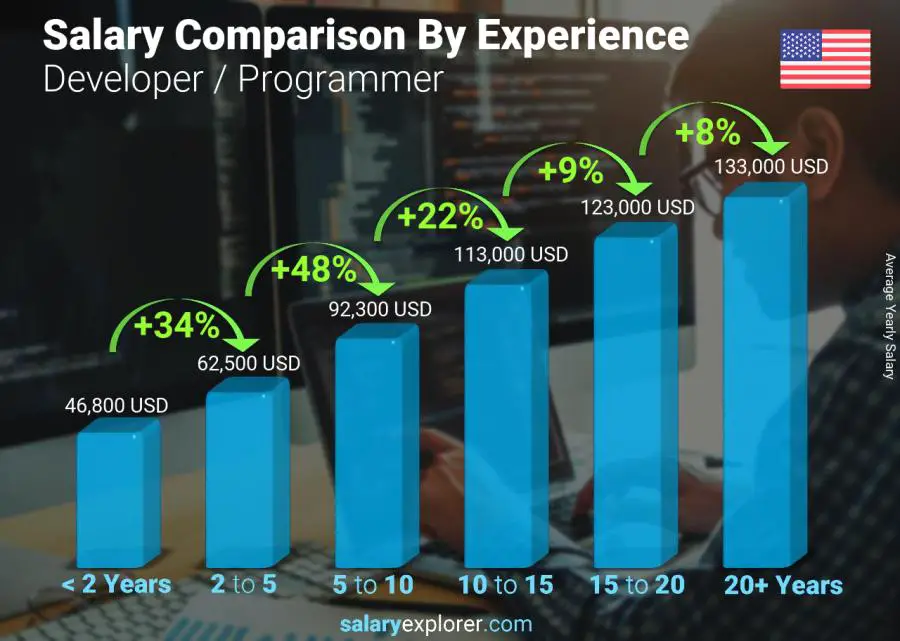
In the below given chart we have prepared a list of the expected costs of a developer based on the undustry they operate in. It is important to note that this data cannot be seen as final, and rather may change with a change in the quality of development.
| Consultancy Type | Consultancy Size (employees) | Hourly Rate | Average Project Size |
|---|---|---|---|
| Enterprise Class | 1,000+ | $385 – $935 | $200,000 – $100,000,000+ |
| Big Business Class | 100 – 1,000 | $220 – $330 | $125,000 – $1,000,000+ |
| Mid-Market Class | 25 – 100 | $110 – $220 | $50,000 – $750,000 |
| Small Class | 5 – 10 | $82 – $137 | $10,000 – $500,000 |
| Freelance Developers | 1 | $27 – $330 | $1,000 – $100,000 |
| Offshore Developers | 500+ | $27 – $55 | $10,000 – $1,000,000+ |
| Nearshore Developers | 500+ | $44 – $82 | $10,000 – $1,000,000+ |
How to Choose a Programmer? – 3 Things to Consider
In today’s economy, there is no scarcity of programmers. Some programmers have more experience and are able to charge more for their services. But at the same time, it is difficult to judge a programmer just from the resume or portfolio that he shows.
Keep these pointers in mind when seeking programmers, especially if you’re a small business or on a tight budget:
1. Choose a reputed company
If you’re recruiting coders or programmers for the first time, it will make more sense if you hire programmers and teams of programmers from reputed companies such as the Hire Indian Programmers. Such companies have mechanisms to hire and nurture great talent and a mix of senior and junior programmers makes sure that all your needs are met. So, if you wish to hire a programmer, it may be better to rent a programmer to start.
2. Hire programmers as per your project requirements
You might have considered freelance platforms already. These websites screen their users and serve as a safe payment mechanism for buyers and sellers. But use them only if your projects are very simple and straightforward. Top notch programmers won’t sit at such places.
They would rather work at a large software company, a high growth startup or be leading their own team. Isolation doesn’t breed talent. So, if you are going to these platforms, be cautious. When you are hiring programmers from a company, you will always get what you want because these companies have a good bench strength in order to give you the kind of programmers you need.
3. Ask for work samples
Always inquire about a candidate’s previous programming experience and, if possible, obtain samples of their work. This way, before you pay them, you’ll know if they’re capable of creating what you desire. This is again true when you are working with freelancers. Good portals may help you get your money back, but they can never compensate you for the time lost in case of shabby work.
Before the job begins, come to an agreement on a project budget or hourly rate. Never forget signing an agreement with a legal business. If anything goes wrong, you still can take hold of the reigns.
Top 5 Tips to Hire a Programmer
Hiring a coder for your project isn’t a one-time event. It is, in fact, one of the most important choices you will ever make. A coder is someone who will construct your company’s internet presence and enable you to engage with your consumers. Many components of the project are inextricably linked to your decision to pick the best applicant for the job.
When evaluating how to hire a coder, you must examine the scope of the project as well as your options for the level of sophistication you require. All of these will form the foundation of your list of requirements for hiring the best coder for your company.
1. Identify and describe the project’s difficulties
Every app development project has its own set of requirements and difficulties. Before you can begin crafting interview questions, you must first determine what your project requires.
Begin by determining the most important aspects of your web development project. The scale and scope of your project will be determined by these factors. You’ll need to locate someone with the necessary talent and experience to handle this scale without sacrificing quality.
2. Give aptitude precedence over undocumented skills
Dedicated web developers may always learn new skills, but obtaining the correct aptitude may not be so easy. Web development projects are fluid, and an intuitive understanding of Application Programming Interfaces is required (APIs).
In a dynamic environment, troubleshooting is akin to changing the tyres on a moving car. When you hire app developers, you want someone who can quickly adapt to the shifting equations of the situation at hand. This does not negate the importance of possessing the appropriate abilities. In fact, to keep up with the fast evolution of technology in the web development industry, you must regularly upgrade your skill level.
3. Draft a transparent job description
You can only hire the right web developer if you have access to a large candidate pool. A major strategy is to attract the ideal candidates to your job offer. A job description’s obligation, however, does not end with attracting and employing the right individual. When hiring remote developers, the job description should be used as the first point of contact with the candidates. At this point, transparency is required.
You should provide all of the abilities and solutions you require from a possible web developer in this description. What you don’t want in your ideal web developer should also be listed in the job description.
4. Set a clear budget
When it comes to selecting a dependable professional for your team, salary negotiations are unavoidable. Setting the correct budget is crucial to attracting professionals who meet your standards. You also don’t want to go over your operational budget right away.
Conducting price surveys prior to creating the job description is the greatest technique to come up with an irrefutable budget. On prominent job portals, you may search into projected salary ranges for similar companies. You can also run a comprehensive competition analysis to determine the current median price for a web developer working on your project.
The budget you select for hiring web developers will be factored into the final cost of your web development. Make certain that the price bundle you provide your web developers justifies the quantity of work that is actually required for the job.
5. Create a solid interviewing system
You interact directly with a potential team member during the interview stage. By starting your interview with trivia questions, you won’t be underestimating this communication. Knowing the answers to program trivia is in no way a criterion of aptitude or skill set for working on a web development project when you hire software developers.
The only approach to properly comprehend the professional spirit and performance measure of your possible web developer is to use a proactive testing strategy. Do, however, set out a portion of the interview to assess their soft skills.
6. Decide on the developer’s skills
Web developers are divided into three categories. Developers who work on the front end, back end, and complete stack.
- Front-end developers work on the front end of your website, which is the area that visitors interact with. You can engage such developers to make minor changes to your website’s design and layout.
- Back-end developers are in charge of the structure of your website, which is concealed behind the front-end, i.e. how it operates. If you want to improve the speed of your website, integrate third-party services into the site infrastructure, or resolve technical issues, you may need the help of a specialist.
- Full-stack developers know how to build both the front and back ends of websites. Such experts are becoming increasingly popular among start-ups with minimal resources.
7. Finding the necessary skills
Consider that when you hire web programmers, you are hiring a technology partner who will become an integral part of your organization for several years, offering continuous technical support and developing additional website enhancements. As a result, you must hire web developers with caution. Will a generalist work better, or should you go for a specialist? Do you require a team leader or require one junior developer. You have to have the answer to this clear in your mind.
8. Verify the expertise and work
You must analyze the candidate’s experience and determine whether he/she can handle your requirements for the upcoming project. As a result, before filling out contact forms, it’s always a good idea to look over the programmer’s portfolio and seek references. Always verify the work done from these references.
Why Outsource Your Development to a Company in India?
Where to find the best programmers for hire is a complicated question. But many businesses have found success by outsourcing software development projects to Asian countries such as India, the Philippines, and Singapore, among others. Out of these countries, India has become the chosen software outsourcing location for the majority of Fortune 500 organizations. This is due to the fact that most software outsourcing companies provide organizations with improved customer service and high-quality products at a low cost.
Outsourcing software development projects to India not only saves money but also helps firms achieve higher ROI and efficiency. Other benefits include:
-
You have the ability to reduce your development costs
Because of the large salary disparity between software specialists in both nations, outsourcing your development project to Indian software businesses might save you a lot of money.
-
Availability of technical expertise and resources
Multidisciplinary development teams with a variety of technical knowledge in sectors like React Native,.NET, Vue JS, Javascript, and others may be found at software development companies all over India. India educates approximately 1.5 million engineering students each year.As a result, India has a significant pool of highly trained and experienced software developers working in a variety of technologies.
-
High-level data protection
To address the problem of data security, the Indian government has imposed stringent security measures to prevent data breaches, hacking, data thefts, and other forms of cybercrime. One of the major advantages of outsourcing to India is the high level of data security available for your projects.
-
Provides a Wide Range Of Solutions & Services
Indian software development firms provide cutting-edge software solutions and services, including custom-built solutions for a wide range of applications, including legacy system migration, robotic process automation, system integration, and more.
The Crux of the Process to Hire a Programmer
All web development projects are unique, and it’s difficult to provide you with specific advice on which web developers will best suit your needs without understanding the scope and goals of your project. But you must always follow a stepwise approach to hiring. You must count in the business problem that you are to solve, the necessary qualities of the coder you need, and then get a complex framework to assess him for the skills you need.
If you are looking to support regarding any programming or development, you can contacts us at Hire Indian Programmers. We offer custom solutions in Node.Js Development, Ruby on Rails Development, WordPress Development, PHP Development, Magento Development, iOS Development, Android Development, Angular Development, OpenCart Development, Iconic Development, Laravel Development, or any Open Source Development.
You May Also Read:
How to hire a programmer for a startup?
Before we jump on to the answer of the often asked question, ‘How to hire a programmer for a startup?’, I feel that it is important to discuss the question, ‘What kind of programmers are needed in a startup?’
Knowing the skills you need to hire a programmer makes your life easier as an entrepreneur or a recruiter. Especially since programmers and coders may have a plethora of skills depending on the technology they work on or the kind of applications they would build.
It is imperative to know that a web developer may not have the same skills as that of a mobile developer, and a mobile developer may work on android or at other instances work on iOS. So, the skills of programmers are vast and suit specific needs.
Aspects of Software Development
There are three critical components in any software/web/app development process. The front-end, back-end, and database architecture that ties it all together. The front end relates to the on screen experience that helps us to interact with the web or mobile software. The back-end refers to the code that sits at the back, communicating all the information from the front end to the database and vice versa. It is more of a messenger that actually makes the system work.
Finally, we have the software architecture that consists of everything other than the front-end and the back-end. Database, hosting, structuring all come under this aspect of software development.
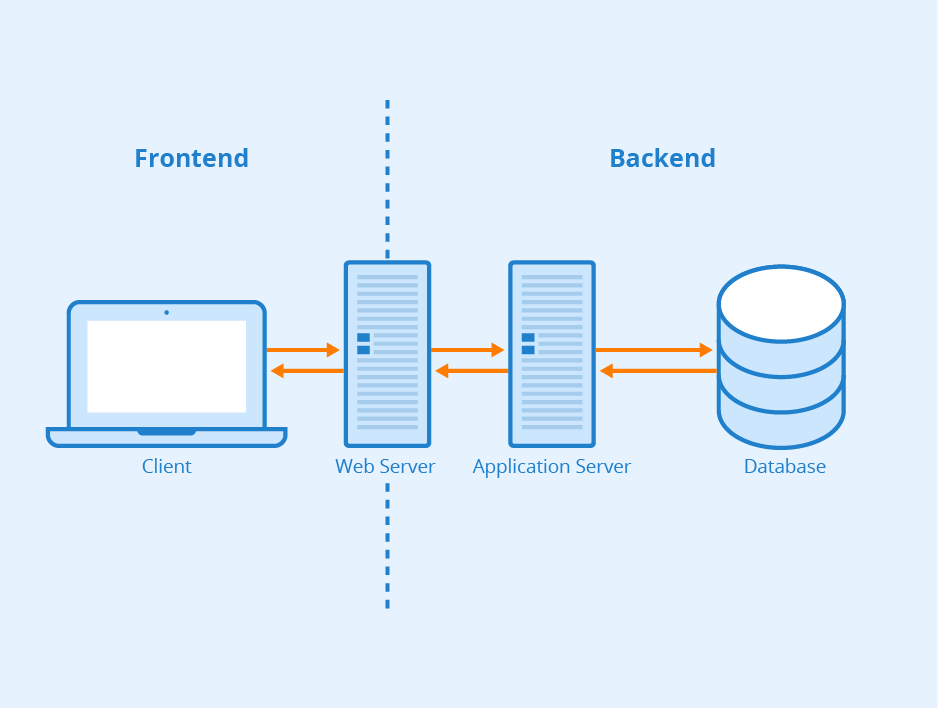
What kind of programmers should you hire for a startup?
Unless you are a technology company whose primary work is software development, you should hire a full stack developer without a doubt. A full-stack developer can work both on the front end and the back end of a software. This means that he has the capacity to build both the server side and the client side of a software.
Although full stack developers might seem costly, they actually are not when it comes to a startup. Since, a full stack developer works on almost any aspect of your software or app, he can come in handy to solve any puzzle that may arise. But hiring a true full stack developer who can help you with your startup idea can be difficult.
It becomes frightening when we get to realise that hiring the wrong person may lead a company to lose millions. Yes, these are documented statistics.
Again, hiring a developer for a startup doesn’t always mean that you need a full stack developer. A lot would depend on the type of product, or the software the startup needs to build. It also depends on whether the software is already built and now needs maintenance and upgrades only.
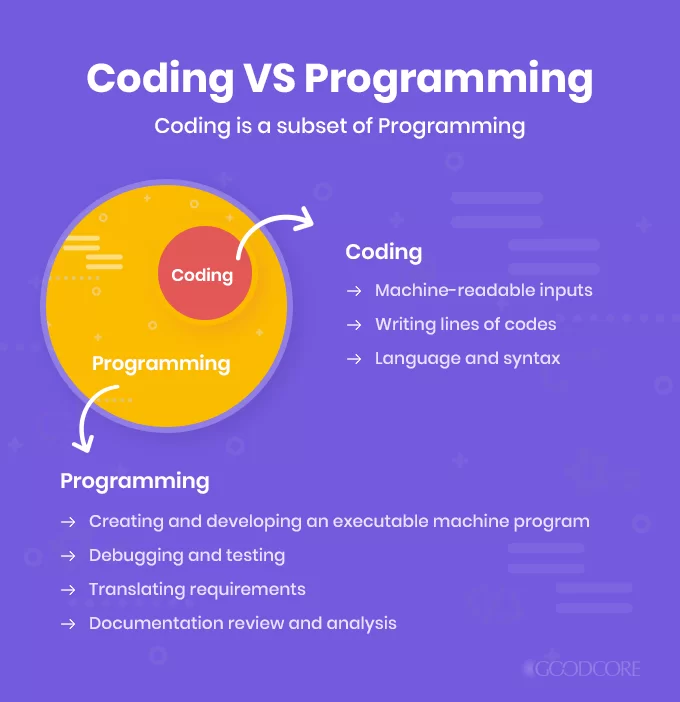
Tip: You can contact experts like those at Hire Indian Programmers: one of the finest software development companies in India to evaluate the kind of programmers that your startup would need.
Summary of the Section
Full stack developers, by definition, are experts in all three areas and can work alone on any web development project without the need for outside assistance. However, they are tricky to hire and you need to be very skilled in recruiting such employees. And there is no one size fits all solution when it comes to hiring, but most of the non-tech startups would do well by hiring a full-stack developer.
Obviously, you would now ask us why? Here’s the answer.
Reasons to Hire a Full Stack Developer for a Startup?
Reasons to hire a full stack developer for a startup might be many, but two of the most important ones are:
1. Full-stack developers help you keep costs down by reducing the number of people you need to hire
Running a startup needs communicating and carrying out clearly stated goals along a less-than-clear road. You do, after all, have a mission statement and a goal in mind. However, unlike established businesses, you must carefully consider every dollar you spend and whom you spend it on.
So, if you’re planning to build up a web/mobile app or any other type of software infrastructure, you’ll need a team of engineers to assist you. It’s ideal to hire distinct developers to handle the backend, frontend, and database. But these specialists will work in their own silos, and none among them would have authority or knowledge about what’s going outside of their own realm.
Hence, with a full-stack developer you can have a single person working on all the facts of your software, website or application development. Hiring full stack developers will always keep your overall team size smaller.
2. Your startup’s full stack developers will expand with it
As I previously stated, it is critical that those who work with you share your goal as a startup entrepreneur. Only a full stack developer would come close to sharing that vision when it comes to the construction and management of your web development infrastructure.
While IT project managers may be in charge of overseeing all that the siloed expert programmers perform, having a full-stack developer grow with the organisation would provide far better long-term benefits.
What are the skills of a full-stack developer?
A full stack developer is not a single entity. He can be of many different types, working on different technologies. But some skills may be essential for a full stack developer.
- HTML/CSS
CSS stands for Cascading Style Sheets, while HTML stands for Hypertext Markup Language. CSS is a customizable tool for creating and decorating a website, whereas HTML is used to add web content. The style and feel of a website are determined by HTML and CSS, which play a significant role in enticing potential clients.
Full Stack Developers must work with HTML to use markup to determine the structure of web pages. For the efficient presentation of HTML elements, they must also be CSS experts. For designing an interactive, intuitive, and engaging frontend for applications, Full Stack Developers must have strong experience in both of these programming languages.
- JavaScript
JavaScript is a required Full Stack Developer expertise when it comes to web and software development. The object-oriented scripting language is mostly used in HTML to implement functionalities. It’s one of the most used languages for building server frontend and backend code. JavaScript is also the only programming language that can be used both in the browser and on the server (Node.js).
Full Stack Developers must be well-versed in JavaScript, as well as related concepts and functionalities such as React and Angular. There are full stack javascript developers as well. Something to consider.
- Backend Languages
While we’ve covered the two most important frontend languages, HTML and CSS (together with JavaScript), the backend is an equally important component of any application or product. While backend development is another game altogether, there are numerous programming languages to pick from.
Few languages like PHP, Python, Ruby, Javascript, Golang, C# etc are used to develop the backend of a software system and full stack developers need to master them.
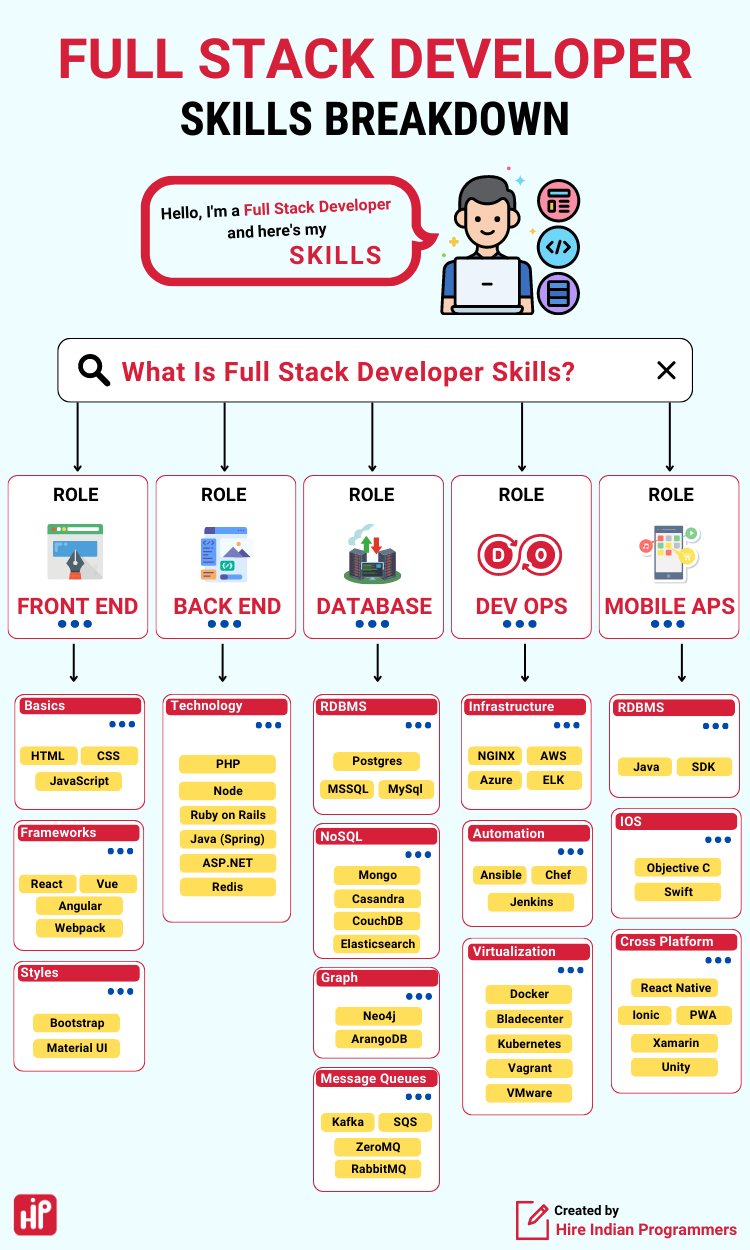
How to hire programmers for a startup?
When it comes to building the next successful product or solution, you need to know how to hire startup developers.
Especially, if you come from a non-technical background, hiring a programmer for your startup is challenging. You must comprehend the complexities of selecting the best candidate for the job. Programmers are wizards in their own right. With their coding, they develop stunning digital solutions.
So, here we bring the simplest process of hiring experienced programmers for your startup:
5 Steps to hire a programmer for a startup
Go by these steps when you are hiring a programmer or a developer for your startup
1. Define What You Want To Build
Before you go all-in on recruiting developers, make a list of your criteria. The more exact you are, the more effective your filters will be.
- You’ll be able to start looking in the proper locations if you have a clear set of talents.
- Your communication will reflect your clarity in what you’re seeking.
- Do you want a database developer or a front-end developer, for example?
- Are you certain you haven’t mixed up a web designer and a web developer?
2. Understand What to Look For
The following step is to set up your search strategy after you’ve defined a need, acquired input from all stakeholders and agreed on candidate specifications.
Sourcing is the process of proactively identifying individuals who are:
- Actively looking for work (active job seekers) or finding those who are not actively looking for work (passive job seekers)
- The technology on which you wish to build your software. Example, you can look for a developer who works on MERN stack.
- The type of experience and skills you are looking for.
- The position where you wish to fit in this new resource. Is he a Team Leader, or a Junior Developer?
3. Where to Look For
If paying for services is not an option, you can use the following resources:
- LinkedIn – Create a Company Page
- Create a career page
- Publish engaging content
- Use free ads
- Github – Filter search results by relevant criteria and contact people who could be of interest.
- Hire Indian Programmers – Hire Indian Programmers is one of the finest Indian Companies that are especially skilled to help startups with their coding needs. Hire Indian Programmers, or HIP is an award winning company that has a plethora of programmers on bench who can be hired on a contractual, project or a tasked based payment system.
The company has delivered a plethora of projects on multiple technologies to clients all over the world. Check out some of their Projects:
- iOS Projects
- WordPress Projects
- Node.Js Projects
- PHP Projects
- Shopify Projects
- Magento Projects
- Android Projects
4. Screening the candidates
A recruiters’ life has been made easier by applicant tracking systems and other recruiting technologies, which have reduced the cost, time, and effort involved in attracting, maintaining, and retaining personnel. You welcome applications, sift manually, interview shortlisted applicants, and are finally employed in traditional tech hiring processes. However, this method is not cost-effective, scalable, or precise.
Some companies, such as HackerEarth or Codility, offer coding assessment software which helps you, screen developers, effortlessly via customized coding tests that are automatically evaluated. Detailed reports paint a near-perfect picture of what these individuals are capable of.
You won’t be accused of any kind of bias either. Sometimes, researching their presence on social media gives you a snapshot of potential hires’ personal and professional personas.
If all you have is a résumé, how do you make sense of a promising developer’s résumé?
5. Start the Interview with Candidate
It’s a two-way road. Both the candidate and you will have to make some decisions in this situation. Once you have a list of “ideal prospects,” you must decide whether they are:
- Are enthusiastic about what they are doing or what they aspire to accomplish
- Can effectively communicate
- Have a thorough understanding of their field of expertise
- Would be someone your team enjoys working with
Hire for their computer expertise and adaptability rather than their experience. Don’t ask for a programmer with five years of Java experience, two years of SQL experience, and one and a half years of Hibernate experience.
Find strategies to examine their area of expertise and online presence (portfolios/GitHub) instead of this shopping list. Ask them open-ended questions and have them evaluate a platform, system, or piece of code. Engage them in a discussion about it, and you’ll learn a lot about their mental agility and problem-solving abilities.
If you are not a techie, you should hire someone (a programmer, mentor, or consultant) to assist you in interviewing developers. Again, companies like Hire Indian Programmers can come to your rescue if the process seems daunting.
4 Key skills of coders to look for when hiring for your startup
- Technical skills – Because of the many different digital languages, a professional in the field has worked with a wide range of them. A programmer who has worked with a variety of languages has a better understanding of the complexity of coding.
- Problem-solving abilities – When an original idea is provided, an expert coder succeeds by figuring out how to make it work.
- A business mindset – The ideal professional coder has a business mindset that allows him to see the big picture and look beyond the software he is currently working on. They can take it a step further by suggesting fresh ideas and ways to better their assignment.
- Ability to plan – A professional understands the need of planning ahead and considering the end product. They can carefully develop their software to ensure that each line of code is successful.
Where to Hire Programmers Online for Your Startup?
Here is the list of websites to hire programmers online for your startup:
With 18 Years of experience in offering expert developers to startups across the globe, Hire Indian Programmers is the best bet if you are looking for top-notch developers. The company offers a multitude of pricing options which will completely be in your favour. You can hire one developer for your startup or even go for an entire team. Once your project is done, they will even offer complete maintenance and upgrade based on your needs.
- Upwork
With over 12 million users, Upwork is a big freelance marketplace. With the use of sorting algorithms, the popular website connects clients with remote freelancers ranging from content writers to JavaScript experts. Upwork’s simplicity of use is frequently praised by employers, but the fluctuating quality is frequently cited as a key negative. So, while finding programmers to interview should be relatively simple using Upwork, interviewing dozens of individuals will be time-consuming.
However, the quality of Upwork freelancers varies depending on the size of the marketplace, as the firm does very little screening. As a result, you will be responsible for the majority of the screening and vetting.
- Freelancer.com
Freelancer is one of the largest freelancing markets in the world, and it’s a terrific location to find talented coders. Freelancer is used by top companies such as Microsoft, PWC, Boeing, and many more, and is known for making the hiring process easier.
Employers and enterprises can hire the ideal developer in just a few seconds thanks to Freelancer’s innovative bidding system. Recruiters can look at portfolios, samples of work, and feedback from former employers. However, if you’re seeking a low-cost option, Freelancer is a fantastic option.
- Remote.co
Remote.co is a website that encourages people to work from home. Because some of the world’s most prestigious corporations encourage remote working, sites like these quickly gain traction. So far, we’ve looked at sites that have large databases of coders for hire; Remote.co, on the other hand, is more focused on job listings.
You may locate freelancers on Remote.co by posting a job on their platform, and a pool of candidates will respond. Unlike a standard freelancer platform, there is no interface for managing payments. As a result, after you’ve found the programmer you’re searching for, you should feel confident in taking hiring into your own hands. Developers, designers, project managers, quality assurance, and IT all have remote job boards.
- Guru
Guru is a popular network for finding and hiring freelancers. Guru is a safe, flexible, and cost-effective platform that links businesses and employers with some of the best freelancers in the world. Guru is a top competition to try when hiring developers because it claims to have a 99 percent client satisfaction record.
Guru also provides round-the-clock client service and currently has over 500,000 brilliant programmers and developers on board. Employers and businesses can comb through the portfolios of numerous freelancers, compare them, and read reviews to make an informed decision. Guru’s SafePay payment option also makes it a safe and secure solution for businesses.
Why Not Hire a Freelance Developer for Your Startup?
It can be difficult to find good help these days, especially in the development and engineering fields. It appears that finding and keeping suitable, competent, full-time personnel is nearly difficult. That is why hiring from companies that allow billed work hours only is such a terrific option.
Freelancers might be recruited to help with a particular issue or forthcoming project. But the quality of work of freelancers is never attractive. Reliance on freelancers does help to keep costs low, but you may never meet your company’s requirements. Freelancers are often unpredictable and non-serious. So, you need to have a contract with an established company so that you can take legal action, in case it’s needed.
There are a plethora of freelancing websites available on the Internet for you to sift through and determine which is the greatest fit for your needs. This liberty has the potential to be a double-edged sword. It’s good because you have access to a large number of applicants, but it’s terrible because there’s simply too much to sort through. We’ll make that process more tangible by laying out some of the greatest solutions available.

3 Traits of a Startup Programmer
A programmer that works in a startup is not the same as one that works in a slow traditional setup. Startups by nature are fast and ever changing. So, when you are hiring a programmer for your startup, check for the following traits.
- Endless patience
The most crucial quality to develop in order to become a great programmer is patience. There may be times when you become stuck while programming, and the only way to get out of it is to keep working. It’s also true that you can’t teach patience, but if you’re interested in programming, you can practise it.
- Possess a high level of creativity and problem-solving abilities
Programmers are regarded as some of the most inventive individuals on the planet. Their job entails looking at an issue from a different perspective and employing code to build a creative solution. You must have a problem-solving mindset if you want to be a successful programmer.
- Analytical reasoning
One of the most crucial qualities we look for in a skilled programmer is the ability to reason logically. You will quickly be able to find solutions to the difficulties if you think logically. All you have to do is think about the solution calmly while applying all of your knowledge and reasoning. What distinguishes a brilliant programmer from others is their ability to approach an issue in a rational, analytical manner.
3 Strategies to Hire a Programmer for your Startup
1. Outsource programming to cheaper locales
You generally don’t require a full-time hire or a development team if all you need is someone to build your website. Outsourcing your programming to a place where lower pay is allowed could be a solid, low-cost option for you. You can locate someone in India to complete the duties you require, thank them, and then go on. You don’t have to hire them on a permanent basis, and if you build a solid relationship with them, you’ll have a resource you can call on as needed in the future.
2. Hire Remotely
Remote hires are a good alternative for part-time or full-time employees for more than just sporadic job needs for your firm. Developers from India are open for you to hire.
You save money by not having to purchase costly office equipment or pay for additional office space for more employees. Full-time remote hires have the same benefits as in-house employees, but it’s still cheaper than hiring someone to work in the office.
According to Forbes, remote workers are more productive (35-40 percent more productive than in-office counterparts), are more authentically engaged with their work (producing higher quality work), miss fewer sick days, have a higher retention rate, and save companies an average of $11,000 per year per telecommuter.
3. Find a startup partner who can code
No, we’re not joking—here’s an example (with 472 million businesses globally, there’s certain to be a nice match for you!).
There are a number of people who make a living off of founding startups and then moving on to the next one and the next… Many former Amazon, Apple, and Google employees are eager to strike out on their own. You can also come across someone who is ready to sell their most recent startup and start a new one.
There’s a growing number of startup entrepreneurs who network and know a lot of other people that are in the same boat as them. Many of them are also coding experts. You’ll want to locate someone who shares your vision and enthusiasm for your business. This is perhaps the most difficult plan to put into action, but if you’re ready to let someone else in from the ground floor, it can work out well.
You’ll need to have your business model built up, from business plan to prototype, in order to locate a partner. Your assets and limits, as well as your financial condition and schedule, must all be fully disclosed. With any luck, your potential partner will share your passion, and the two of you (or more) will be able to work together to create your business until you’re ready to expand your workforce.
Where do you think you’ll be able to meet these potential partners? Websites such as F6S.com and CoFoundersLab; coworking spaces; startup weekends; developer meetings and conferences; hard tech sites such as GitHub and Stack Overflow; business-oriented blog sites such as Medium.com; and social networking sites such as LinkedIn are just a few examples.
Why hire a coder from India for your Startup?
Many firms in Europe and the United States are willing to hire software developers from India with more experience in order to take their software technology to the next level. Companies have turned to custom software development outsourcing due to a scarcity of qualified and talented individuals on the west side.
Many organizations benefit from offshore software development since it allows them to remain highly competitive and expand their market into other nations. Your costs will simply go down as the price of programmers for startups in India is considerably lower than that of coders in Europe and Americas.
The cost of hiring Indian coders for your startup is not low due to the skills. It is because, being a populous country, India produces 1.5 million engineers every year. This means that there is tougher competition in terms of skills and salary in India. So, do not shoo away this option, especially when you can save a ton of money.
Why is India the best place to hire coders from?
To be honest, India has a wealth of skills in a variety of sectors. More importantly, in the IT area, there are a plethora of skills just waiting to be discovered. India, in general, has a strong growth outlook and a large youth population, making it the most sought-after offshore recruiting destination. India is currently leading the pack by awarding more top-tier offshore projects than any other country.
Many of the most well-funded initiatives have grown more successful because of the contributions of Indian software engineers.
Choose Programmers Wisely to Build a Powerful Product for Your Startup
We have dealt with the issue of hiring a programmer for your startup in as much detail as possible. However, there is no one size fits all approach to hiring. So, before you hire, you have to be aware of your needs and what traits you’re looking for in a developer. Interviewing and onboarding the developer is another area where you have to be strategic. Just in case, it is too much of a task, you can opt for great companies such as Hire Indian Programmers to do all the coding for your startup.
If you are looking to support regarding any programming or development, you can contacts us at Hire Indian Programmers. We offer custom solutions in Node.Js Development, Ruby on Rails Development, WordPress Development, PHP Development, Magento Development, iOS Development, Android Development, Angular Development, OpenCart Development, Iconic Development, Laravel Development, or any Open Source Development.
You May Also Read:
The Advantages of Node.js – A Complete Guide
Developed on the JavaScript V8 Engine of Google Chrome, Node.js is a popular open-source runtime environment. It is used by some biggest companies and start-ups alike.
To name a few, its users include Netflix, Uber, Paypal, and Linkedin, while more than 43% of Node.js developers use it for enterprise apps. Developers love to use Node.js as it allows them to build fast, scalable, flexible, lightweight, and cross-platform mobile and web applications.
In simple words, Node.js adapts JS functionality to backend programming.
The motive of Node.js creator, Ryan Dahl, was to empower developers to use the same technology stack for entire web development projects. This way, there is no need to learn new server-side platforms like PHP, Java, or .Net.
Moreover, the structure of Node.js is the core reason for its popularity.
Within three years of its debut in 2009, Node.js extended its application from Linux and macOS to Windows.
Today, the OpenJS Foundation is an umbrella organization with a massive community of developers for Node.js support. With 50% of positive responses, Node.js was considered the most popular tool in the “Frameworks, Libraries, and Tools” category in a 2019 Stack Overflow survey.
This guide will help you answer What is Node.js used for? What are Node.js advantages? Its different features and industry trends. So, let’s get going.
Specific Features of Node.js
Here are some exciting features of Node.js which lie at its core and make it a popular choice in the industry.
1. Non-blocking I/O –
The event-driven architecture of Node.js uses a non-blocking I/O system that allows you to process multiple requests concurrently without any delay.
In simple words, in traditional synchronous programming, every request blocks a thread, while all subsequent requests have to wait until the processing is finished.
In Node.js, to remain lightweight and efficient, each request uses the same thread one after another instead of starting a separate thread for each request.
As a result, your mobile or web app will require comparatively less RAM, perform faster, and become highly scalable. Here, Node.js, with its event loop mechanism, fills the gap by handling a large number of user requests with high throughput.
2. Libuv
What allows continuous processing of a single thread? Linux is the answer. It is a multi-platform C library designed for the Node.js environment to abstract non-blocking i/o.
Behind the scenes, this multi-platform support library (Libuv) creates a pool of threads to make synchronous into asynchronous. Additionally, it interacts with the OS, which manages the timing.
3. Node Package Manager
Node package manager (or ‘NPM’) is a default tool with every Node.js installation. The NPM does some crucial things. Firstly, it is a free marketplace of Node.js packages – a group of publicly available, reusable components. Further, developers can use it as a command-line service to interact with the repository.
There were approximately 1.3 million packages on the NPM registry in April 2020, and millions of worldwide programmers rely on it. In addition, NPM is a free online repository of Node.js projects with version management support.
Node.js Resources:
To start your development project with Node.js, here are the resources to refer to and install, including the runtime environment, Node Package Manager, editing tool, and Node.Js frameworks.
- Download: Install the latest versions of Node.js source code or a pre-built installer (including the newest NPM version) for Windows and macOS. Happy development!
- IDE: Since Node.js is a back-end Javascript-based environment, almost any integrated development environment (IDE) or code editor will support it.
However, to fully leverage Node.js true potential, you should prefer specific IDEs or customize your existing editors as per your need. Most developers use specific tools like Visual Studio Code, Sublime Text, WebStorm, Atom, and Eclipse.
- Documentation: Find the various types of docs available for Node.js here. You can find API reference documentation, ES6 features, and Guides.
- Framework: Microservices are best developed with Node.js. The Node.js repository contains Express and Koa frameworks, making it easy to mount multiple server instances for microservices and design routing addresses.
What is Node.js used for?
Node.js outshines other back-end frameworks and programming languages in developing real-time web/mobile applications with its ability to use Javascript for both front-end and back-end.
Node.js embarks a new way of software development with its even-based I/O architecture. This means you can initiate two-way communication between the client and the server.
Below are the reasons why Node.js surpasses traditional frameworks:
-
Real-time applications
Till now, we have understood that using Node.js ensures fast and efficient applications, and its textbook example includes real-time chat or messaging apps.
Real-time applications need a steady connection between server and client. Further, there ought to be no lag or delay from the time request is laid and the callback occurs.
Today, online communication can be exchanged for text, audio, or videos. Also, chats can be one-to-one or one-to-many. Node.js supports Websockets, which is the industry’s one of the best real-time communication solutions.
Along with this, Node also has an Event API. This API allows developers to create particular objects (“emitter”) that systematically issue events such as “listened” by event handlers. This helps in implementing server-side events and push notifications.
-
IoT applications
The Internet of Things is a collection of physical devices that share data via the internet, such as sensors and actuators. Data flow is generally from devices to servers, where it is processed and finally sent to the user applications.
An IoT system may comprise any number of devices (can be in thousands). Such scenarios make managing data streams between the devices and servers challenging. Node.js is an optimal solution here.
Using Node.js for the back-end in IoT applications ensures it processes multiple concurrent requests and data streams emitted by devices. Thus, servers of Node.js work smoothly and do not get blocked.
Also, Node.js serves as a fast and smooth application layer between IoT devices and databases. The developers can also leverage the low memory requirements of Node.js.
-
Collaborative tools
Real-time collaboration tools allow concurrent access on the same app, i.e., multiple users working simultaneously on the same app in real-time. In today’s world, where remote working is a norm, more and more collaborative applications are being used.
Some of the most famous examples of collaboration apps include “Slack” for group chats, Google Docs for online collaborative editing of a doc, and Trello for project management.
Here Node.js is a perfect fit as collaborative apps generate many events and I/O requests concurrently. Moreover, Node.js asynchronous and event-based architecture ensures all users have a coherent application view.
Node uses its WebSockets and Event API to ensure that all the extensive data and requests from multiple users do not make the server hang. Also, it makes sure to deliver all server-side data to the client without any delay.
-
Data streaming applications
Streaming applications are a type of on-demand software apps. Apps like these send large amounts of information in small chunks instead of one large package. This reduces the server load as well as frees the local device.
Also, such apps can run without any internet connection once a batch is downloaded. The most famous examples of streaming apps are Netflix, Hotstar, and more.
The Stream API is a Node.js feature that enables data streaming. Developers can create and process both readable and writable data streams.
-
Applications relying on scalability
Node.js was created to support scalability. It is a lightweight technology that you can use to develop apps to sustain high peak loads. Apps based on micro-service architecture such as the global taxi network “Uber” and social media apps like Linkedin consider Node.js the best solution.
The Node.js environment supports multiple independent nodes to run parallel and communicate. This enables developers to stack more micro-services on each other.
Also, the cluster module in the Node.js balances load for every running CPU core. This way, the environment balances the workload and does not affect the performance.
Top 10 Advantages of Using Node.js
A User Survey on Node.js highlights its positive impact on the business primarily because of increased developer productivity and reduced costs. The possibility of Javascript for both front-end and back-end programming is at the core of Node.js advantages. Here’s more:
1. Robustness
Backend development with Node.js offers multiple advantages over full-stack JavaScript development. These essential benefits include speed, better efficiency, improved productivity, code sharing, easy knowledge transfer, and many free resources and tools.
On top of it, it is a part of the MEAN stack (MongoDB, Express.js, Angular, and Node.js) which are today the most crucial part of web development.
2. Fast-processing
You can count on Node.js to be fast, reliable, and safe. Google Chrome’s V8 Javascript engine powers Node.js. The V8 library is written in C++ and compiles the JS functions into machine code in no time.
Check yourself how fast the V8 is here. Another reason which makes Node.js fast is its suitability with the micro-service architecture.
3. Easy learning curve
For a long time now, Java script has been a popular choice for front-end development. However, since Node.js is based on Javascript, it is easier for designers and front-end developers to grasp and use it for the backend. As a result, it requires less effort and saves time learning server-side programming.
4. Large active community
Another key benefit of using Node.js is its sizable active community that you can find on GitHub or Stackoverflow. Being an open-source project, tons of Javascript developers contribute to the growth of this environment.
Node.js is governed by the OpenJS Foundation that supports its enhancements. Also, you have access to a lot of reusable code for your mobile or web application development project. You can also review codes and find answers if you get stuck in these communities.
5. Better ecosystem
The npm registry in Node.js offers thousands of free code packages for you to reuse. The npm ecosystem is open to all and free of cost. This plays a vital role in advancing technology and makes the Node.js ecosystem rich.
6. Easy & Fast Scalability for Modern Apps
The true advantage of the Node.js environment is scalability, better than any other backend platform. Node.js allows developers to scale their applications both vertically and horizontally.
Since each node in Node.js works around an event, multiple nodes can run simultaneously and communicate independently. On top of it, you can add limitless numbers of nodes to the Node.js core. The room to grow your application is the crucial benefit of Node.js.
7. Cross-platform development
Discussing the advantages of Node.js brings to light its cross-platform support. It’s common these days where a mobile app links to a desktop app. Node.js can be used as cross-platform mobile development for Cordova, Apache, Titanium.
In simple words, you can directly transfer your mobile application code to the desktop app. Isn’t it great? You can save significant time and money.
8. Access a single programming language
Javascript is a popular front-end language, and Node.js uses Javascript for backend programming. So now developers don’t have to learn and invest in different server-side programming and use Javascript for both.
Node.js has made it flexible and easy for developers to switch from front-end to back-end. Also, businesses can hire Javascript developers for the entire development project.
9. Efficient caching with better flexibility
In discussing the advantages of Node.js, caching facility is a crucial benefit. Node.js supports single module caching. Therefore, as the request is made to the app, the first module is cached in-app memory. This allows the application to run efficiently and load faster.
10. Highly extensible with full-stack Javascript
With the javascript foundation, Node.js developers get extensive support for tools. In addition, Node.js opens the door for front-end developers to do back-end programming. Node.js made full-stack Javascript a reality.
Top Examples of Node.js Products
Node.js has been widely accepted for its scalable, fast, and event-driven architecture. Some big names in the industry rely on the Node.js environment for its different advantages. Here are the major players using Node.js:
- Netflix, a global online media network with nearly 192 million subscribers in 2020, uses Node.js for its scalability and data-intensive usage.
- Paypal is another company with more than 400 million active accounts that use Node.js for development. Additionally, Paypal stated that their app improved after migrating from Java to Node.js, and response time decreased by 35%.
- In 2020, LinkedIn embarked on over 722 million users. Microsoft wanted to leverage two main Node.js advantages, i.e., better scaling and communication with other services.
FAQs on Node.js
Welcome to the real-time web. Here is a glimpse of some of the most frequently asked Node.js queries for your basic understanding:
1. Is Node.js Front End or Back End?
Node.js is a back-end runtime environment based on Javascript. Although it can also be used as a front-end framework because it is easy to work with when combined with other frameworks.
2. Is Node.js a framework?
No. Node.js is neither a framework nor a library. Instead, Node.js is an environment with back-end frameworks within it. Some examples are Express and Socket.
3. Is Node.js easy to learn?
Yes, Node.js is easy to learn and implement since it is Javascript. In addition, since JS is a popular front-end programming language, it becomes easier to switch developers to the backend.
4. Why learn Node.js?
Learning Node.js has many benefits for developers. It is popular because it has an open-source and active Javascript ecosystem. In addition, its cross-platform support enables translating mobile apps into desktop applications. The list of advantages is long, and it is easier to learn.
5. What are Node.js Challenges?
Node.js is a single-threaded environment, making it a poor choice for high computational servers and applications. In addition, the heavy computation puts a high load on the server’s response time.
6. What are the advantages of Node.js over PHP?
PHP is a scripting language, while Node.js supports server-side events and WebSockets. As a result, Node.js is easier to implement and suitable for all applications, including IoT, chats, or social media. On the other hand, PHP is optimal for standard solutions like websites, blogs, and CMS, where Node.js may not make severe improvements.
7. Is Node.js better than Java?
Node.js is single-threaded, which is its advantage and disadvantage. For high-load applications with extensive calculations, Java will work better. In all other cases, Node.js is faster, scalable, and flexible.
8. Is Node.js used for startups?
Node.js is heavily used by unicorns and early startups alike, including companies like Netflix, Uber, Groupon, and more.
Conclusion
No wonder Node.js is so popular. It is a powerful tool to develop fast, efficient, scalable, and lightweight mobile and web applications. But, of course, nothing is perfect, and Node.js also has advantages and disadvantages.
However, its great ecosystem and agile design make it ideal for startups and big companies alike. Unless you want to develop a CPU-intensive application, the pros of Node.js outweigh its cons.
Want to develop an app for your startups? Contact us for any web application development and accelerate your business by hiring our Indian developers now.
Read More:
Node.js vs PHP: Which is better for backend development?
NodeJS vs AngularJS: Which is The Best For Your Project?
How to Successfully Wrap up your Web Development projects?
6 Best WordPress Cache Plugins to Speed-up Your Website [3 are Free]
Once you launch a website, you need to think about ways to get more traffic on it. That is why most of us focus on different ranking factors that help a website rank higher on SERPs. This process is called SEO or Search Engine Optimization. Among the various actions to consider while optimizing a website is the one related to the load times of a website.
When clients hire developers for creating their business websites, these developers often have to consider all the nitty-gritty associated with the technical aspects of SEO. Caching is one of the most important of them. Every specialist SEO and web developer knows that caching can be used to increase the speed and the performance of a website. That is why there are many plugins to do this job in case you do not have a developer. And in this blog post, we will talk about the 6 best WordPress cache plugins to boost your website speed.
What is Caching?
Simply put, caching is the process of storing files in a temporary location. This helps in quicker access to these files. We may say that a cache is any temporary storage location, but caching is more often used in favor of internet-related technologies.
What caching essentially does is that it turns dynamic pages into static ones, thereby helping the website in loading faster on a customer’s browser. There are two kinds of caching – server-side and client-side caching.
What is Client-Side Caching?
Client-side cache copies the information from previously downloaded files inside browser applications, or with other clients (such as intermediary networks caches). This is the most effective kind of cache, as it permits browsers to access files without communicating directly with the server.
What is Server-Side Caching?
The server cache can be described as a sort of cache that’s connected to caching for websites, however, instead of storing content on the client’s side, the cache is stored on a server. Server caching is managed and controlled by the server, without the involvement of the user, or even a browser.
What is Browser-Side Caching?
Browser caches are a type of cache that occurs on the client side. It is a form of caching meant only for websites. It operates exactly the same way and is a cache system that is built into the browser. Content and files that are saved are saved to your computer and are then placed together with other files that are associated with the browser you’re using.
How to do Caching?
When you have a developer in your team, you don’t need to worry about it and he will take care of the caching himself. But when you do not have one developer who can custom code a plugin for you, it is time to consider other plug and play options. And that’s when we need to learn about some WordPress caching plugin options.
There are some WordPress caching plugins that make caching from the client-side a breeze. As dedicated WordPress programmers, we have come up with this blog post wherein we will list out some of the useful client-side WordPress plugins for caching.
Want professional help on your caching needs? Hire the best Indian WordPress programmers.
Top 6 WordPress Cache Plugins
Our team at Hire Indian Programmers continuously works on a multitude of WordPress Projects for clients across the globe. Over the last decade or so, we have tried and tested all the WordPress cache plugins and now we are in a position to advise you on the best 6 caching plugins for WordPress that you can immediately put to use.
1. WP Super Cache
WP Super Cache is a top WordPress Caching plugin, developed by the team at Automattic. The plugin is quite a popular caching plugin amongst WordPress Developers and the reasons are manifold. Website owners who want to allow room for greater customization and serve with lightweight static files can check this plugin out.
Anyone looking to use the plugin can readily download the plugin for free from the WordPress plugin repository. The best thing about this plugin is that it incorporates three different caching modes – Expert, Simple, WP-Cache, and WordPress Programmers can choose any of the three according to their needs.
2. Hyper Cache
Hyper Cache is among the best cache plugins for WordPress that can be downloaded from the WordPress plugin repository for free by developers. Hyper Cache is most suited for clients who are looking to develop both desktop and mobile versions of their websites. The reason is that it has provision for double cache for mobile and desktop versions.
Besides, it comes with a set of defaults that are tuned to work after activation. The plugin is quite flexible, given that it supports both low-cost shared hosting plans and custom configurations. Undoubtedly, this is one of the best free cache plugins for WordPress.
3. Comet Cache
WordPress experts familiar with ZenCache can easily migrate their options and other settings over to Comet Cache. This plugin is sort of the spiritual successor of ZenCache. Both free and premium versions are available. Since it has a free version, we can add this to the list of best free cache plugins for WordPress.
The plugin comes with a set of pre-configured options that makes the setup process for WordPress Programmers to start their caching in a jiffy. The Premium version is more oriented towards clients hiring WordPress Developers to create heavy sites that collect data (membership sites).

4. W3 Total Cache
Without a doubt, this is one of the most sought-after WordPress plugins for caching. This performance plugin for WordPress websites is one that our WordPress programmers always recommend. We at Hire Indian Programmers have also made use of this plugin in several projects. This can be downloaded from the WordPress repository for free. The caching scope is boundless, for it caches everything from pages to database objects.
For clients hiring dedicated WordPress programmers with a specific mandate of providing e-commerce solutions, this plugin is the most ideal. Given that it is versatile and used by several popular publications, W3 Total Cache also supports Accelerated Mobile Pages (AMP) and several kinds of hosting solutions.
5. Sucuri Firewall
With this WordPress caching plugin, you can increase website speed by 70%. Sucuri offers caching solutions and has its own global Content Delivery Network (CDN). Although there are numerous caching options are available for all kinds of websites, but only a few are the ones that can improve the performance of a website in real time, and Sucuri Firewall is one of them.
Security and speed optimization in one plugin are rare to find, but this plugin is apt for both. With this, you can keep your website functioning 24/7.
6. WP Rocket
Finally, we have WP Rocket – specifically for those businesses hiring dedicated WordPress Developers to design and support very heavy websites and seek faster page load times. Priced at around 50$ per year for one website, the plugin does the job pretty neat. The price is justified by the constant improvements implemented by the team behind WP Rocket. One of its key features is the loading of images on request. What’s more? Apart from the usual caching features, it is very much developer-friendly. Experienced WordPress Programmers can add their own tweaks.
Over to You
These are the best caching plugins for WordPress that will improve the performance of your website. Now, which one you should choose is a very different question. You would need to assess many different factors to zero down on one. Generally, plugins conflict with one another and you need to opt for the one which you know will not cause any issues in the overall working of your site. This is the reason you need to get in touch with a WordPress developer to talk about it.
With this, we come to the end of this blog post where we put all our knowledge regarding the best WordPress Caching plugins out. We hope you found this article to be useful.
Are you looking to hire dedicated WordPress Developers for your website? Hopefully, your search ends here. Contact us, explain your needs and we will get back to you with our custom-tailored services.
Read More WordPress Related Resources: